Econumo vs GnuCash #
GnuCash is one of the oldest and most respected open-source finance projects in existence — development began in 1997, and it is still shipping quarterly releases nearly three decades later. Econumo is a self-hosted budgeting web app, in development since 2020 and open-sourced in November 2024.
Comparing them is less about which is better and more about which category you actually need: double-entry accounting or household budgeting.
The short version
Choose GnuCash if you want rigorous double-entry bookkeeping, investment and share tracking, or the strongest multi-currency accounting engine available for free — and you are happy in a desktop application, on your own. Choose Econumo if you want envelope budgeting, access from a phone or any browser, and a shared budget with your household. GnuCash does none of those three well.
At a glance #
| Econumo | GnuCash | |
|---|---|---|
| Licence | MIT | GPL-2.0-or-later / GPL-3.0 |
| Price | Free self-hosted; $29.99 one-time cloud | Free |
| In development since | 2020 | 1997 |
| First public release | November 2024 | 1998 |
| GitHub stars | 79 | 4,290 |
| Releases on GitHub | 24 | 75 (2015 onward only) |
| Latest release | v1.1.1 (19 Jul 2026) | 5.16 (28 Jun 2026) |
| Cadence | Feature-driven | Strict quarterly, ~4/year |
| Form factor | Self-hosted web app | Desktop application (GTK) |
| Platforms | Any browser | Windows, macOS, Linux |
| Language | Go | C / C++ / Scheme |
| Storage | SQLite or PostgreSQL | XML file, or SQLite/MySQL/PostgreSQL |
| Accounting model | Envelope budgeting | Full double-entry |
| Envelope budgeting | ✅ | ❌ Ledger-delta budgets only |
| Household sharing | ✅ Per-item access | ❌ Single-user |
| Mobile | PWA | ❌ Android app unmaintained since 2018 |
| Multi-currency | ✅ | ✅ Best in class |
| Investments / shares | ❌ | ✅ With auto price quotes |
| Bank sync | ❌ CSV import | ⚠️ AqBanking (mostly EU banks) |
| API | ✅ REST + Swagger | ❌ Python/Scheme bindings only |
Figures observed 18–19 July 2026 from the GitHub API, gnucash.org and each project’s documentation.
Licence #
This is the one place where the two differ in a way that could matter legally.
Econumo is MIT — permissive, with no obligation to publish changes. GnuCash is GPL-2.0-or-later / GPL-3.0, a copyleft licence: distribute a modified GnuCash and you must release your modifications under the same terms.
For an individual user this makes no practical difference. For anyone building a product on top, MIT is the less demanding choice.
Note: GitHub’s licence detector reports GnuCash as NOASSERTION because its
LICENSE file is a composite; the file itself specifies GPL v2 “or, at your option,
any later version”, with an OpenSSL linking exception on some files.
Price #
Both are free. GnuCash has no paid tier, no hosted service and no commercial edition — it is funded by donations. Econumo’s self-hosted edition is likewise free, with an optional hosted cloud account at $29.99 one-time per user.
Since GnuCash runs on your own desktop, there is nothing to host and no running cost either way.
Popularity and longevity #
GnuCash’s popularity is best measured in decades rather than stars.
| Econumo | GnuCash | |
|---|---|---|
| GitHub stars | 79 | 4,290 |
| Forks | 2 | 963 |
| Contributors | small core team | ~317 |
| Age | ~6 years | ~28 years |
| Downloads | ~21,000 across two registries | ~67,000 in 3 months (SourceForge) |
Roughly 22,000 people download GnuCash every month, three-quarters of them on Windows. Its star count understates it badly — GnuCash predates GitHub by a decade, and much of its community lives on mailing lists, Bugzilla and its own wiki rather than on GitHub.
On project longevity, GnuCash is in a class of its own. Very little software of any kind has shipped continuously since 1998. If your main worry is a project disappearing, that record is hard to argue with.
Release history #
GnuCash runs one of the most predictable release trains in open source: a stable release in late March, late June, late September and mid-to-late December, every year.
| Version | Released |
|---|---|
| 5.16 | 28 Jun 2026 |
| 5.15 | 29 Mar 2026 |
| 5.14 | 21 Dec 2025 |
| 5.13 | 28 Sep 2025 |
| 5.12 | 29 Jun 2025 |
The 75 releases visible on GitHub only reach back to 2015 — the project’s true release history runs to 1998 and is catalogued on gnucash.org.
Econumo, by contrast, has shipped 24 public releases since November 2024 on a feature-driven cadence, reaching 1.0 — and a Go and React rewrite — in July 2026.
Features head to head #
Budgeting — Econumo’s core, GnuCash’s weak spot #
GnuCash is a general ledger with a budget feature attached, and this is consistently identified as its weakest area.
Its budget works by ledger deltas: you enter an expected change per account per period, and GnuCash reports actuals against that expectation. There is no envelope model, no moving money between categories mid-month, no per-envelope rollover, and no intra-period tracking. The project’s own wiki maintains a long-standing Budget Requirements page enumerating what is still unimplemented, and reviewers regularly report that users never quite get the budget feature to fit how they think about money.
Econumo is built the other way around — budgets are the primary object, organised as envelopes in folders with limits and available amounts.
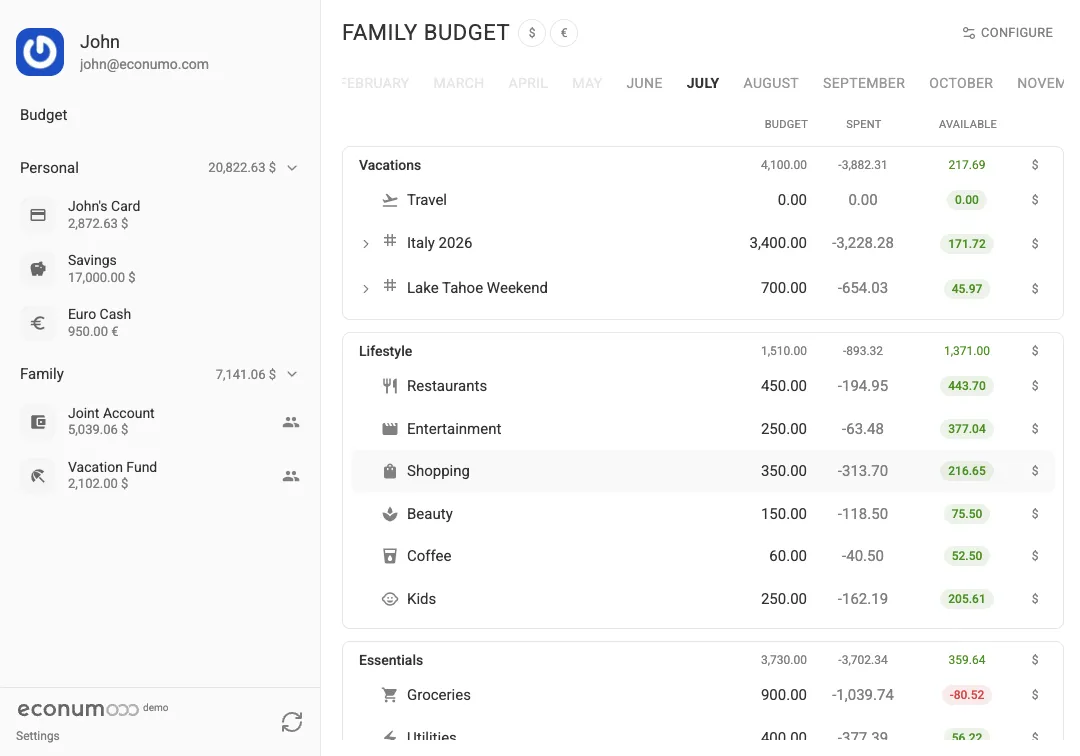
Econumo’s envelope budget. GnuCash’s budget screen is a per-account grid of expected period amounts.
If you specifically want envelope budgeting, GnuCash is the wrong tool — and the GnuCash community will generally tell you the same.
Accounting rigour — GnuCash’s core, Econumo does not compete #
The reverse is just as true. GnuCash offers full double-entry accounting, with every transaction balanced across accounts. It handles:
- Stocks, bonds and mutual funds, with automatic price quote retrieval
- Depreciation, accounts receivable/payable, invoicing and payroll basics
- Small-business accounting
- Scheduled transactions and a full reporting engine
- Fixed-point arithmetic throughout, avoiding floating-point rounding error
Econumo does none of this. It is a personal and family budgeting app, not a bookkeeping system, and it has no investment tracking.
If you need to track a share portfolio or run books for a small business, choose GnuCash.
Multi-currency — both strong, GnuCash deeper #
Both handle multiple currencies properly, which puts them ahead of much of the field.
GnuCash is the more powerful engine: per-account currency denomination, cross-currency transactions fully balanced through double-entry, automatic FX and security price retrieval via Finance::Quote, and fixed-point arithmetic.
Econumo gives each account a fixed currency, records both amounts on cross-currency transfers, and converts the whole budget into a single currency so totals reconcile — see Multi-Currency. That is what a multi-currency budget needs, without the accounting machinery.
Access and sharing — the practical difference #
This is where the 28-year age gap shows most.
GnuCash is a single-user desktop application. There are no user accounts, no permissions and no per-user views. Even with a SQL backend, concurrent multi-user editing is not supported — sharing means passing a file around, or sharing one database with locking. There is no web interface.
Mobile is effectively absent. GnuCash for Android last released in June 2018 and is unmaintained; it was only ever a capture tool that exported back to the desktop, never a sync client.
Econumo is a web app: any browser, any device, installable to the home screen on iPhone, Android, Mac and PC. Two people can hold separate logins and share specific accounts and budgets at a chosen access level.
For a couple who both want to add a transaction from their phone in a shop, this is decisive.
Bank import #
GnuCash imports QIF, OFX and CSV files, and supports live connections through AqBanking — HBCI, EBICS and OFX Direct Connect. In practice, live bank sync is largely a German and European story. GnuCash’s own wiki describes OFX Direct Connect as an obsolete protocol that most banks had stopped offering by 2024, so most users outside the EU are on file import.
Econumo has no automatic bank import at all — this is a deliberate decision — offering CSV import and export and a REST API instead.
GnuCash wins here, with the caveat that its live-sync advantage mostly applies to European bank customers.
Learning curve #
GnuCash’s most-cited complaint, ahead of even the dated GTK interface, is that you need to understand double-entry accounting before you can be productive. For someone who wants to know whether they can afford dinner out, that is a substantial barrier. Its report builder also draws consistent criticism for being clunky and hard to customise.
Econumo asks you to understand envelopes, and nothing more.
Which should you choose? #
Choose GnuCash if:
- You want real double-entry accounting and understand it, or want to learn
- You track investments, shares or a small business
- You need the deepest multi-currency and price-quote support available for free
- You are in Europe and want live HBCI/EBICS bank connections
- You work alone, on one desktop computer
- Three decades of continuous development is your definition of safe
Choose Econumo if:
- You want envelope budgeting rather than a general ledger
- You want to use it from a phone or any browser
- You want to share a budget with your partner or family, each with a login
- You want multi-currency budgeting without an accounting course
- You want a hosted option for a single $29.99 payment
These tools are different enough that “both” is a reasonable answer — GnuCash for the books and investments, Econumo for the household budget. You can try Econumo by starting a free trial.
Frequently asked questions #
Is GnuCash good for budgeting? #
Budgeting is GnuCash’s weakest area. It offers ledger-derived budgets — an expected change per account per period — with no envelope model, no moving money between categories and no per-envelope rollover.
Can my partner and I use GnuCash together? #
Not really. It is a single-user desktop application with no user accounts or permissions; sharing means sharing a file or database. Econumo has per-user logins and invitation-based sharing per account and per budget.
Does GnuCash have a mobile app? #
Not a maintained one. GnuCash for Android last released in June 2018 and was only ever a companion capture tool. Econumo is a responsive web app installable to the home screen.
Is GnuCash still actively developed? #
Yes — a strict quarterly release train, about four releases a year, with 5.16 shipping on 28 June 2026.
Which has better multi-currency support? #
GnuCash has the deeper accounting engine, including automatic price quotes and fixed-point arithmetic. Econumo covers what multi-currency budgeting requires without the accounting complexity.
Last verified 19 July 2026 against the GitHub API, gnucash.org and each project’s documentation. If you spot something out of date, let us know.