Econumo vs Actual Budget #
Econumo and Actual Budget are both open-source, self-hostable, envelope-style budgeting apps released under the MIT licence. They overlap enough that people routinely evaluate one against the other — and they differ enough that the right answer is usually obvious once you know which two or three things you care about.
This page compares them on licence, price, popularity, release history and features. Where Actual Budget is the better tool, it says so.
The short version
Choose Actual Budget if you bank in a single currency and want automatic bank synchronisation, a large community and the most mature open-source budgeting codebase available. Choose Econumo if you budget in more than one currency, want built-in family sharing without standing up an identity provider, or want a hosted account you can simply pay for once.
At a glance #
| Econumo | Actual Budget | |
|---|---|---|
| Licence | MIT | MIT |
| Self-hosted price | Free | Free |
| Hosted price | $29.99 one-time, per user | No first-party hosting (PikaPods ≈ $1.50/mo) |
| GitHub stars | 79 | 27,595 |
| Contributors | Small core team | 463 |
| Releases to date | 24 | 59 |
| In development since | 2020 | 2022 as open source |
| First public release | November 2024 | April 2023 |
| Latest release | v1.1.1 (19 Jul 2026) | v26.7.0 (2 Jul 2026) |
| Language / stack | Go, single binary | TypeScript / Node.js ≥ 22 |
| Database | SQLite (default) or PostgreSQL | SQLite |
| Budgeting method | Envelope | Envelope / zero-sum |
| Multi-currency | ✅ Native, per account | ❌ Not supported |
| Family sharing | ✅ Built in, per-item access | ⚠️ Requires external OIDC provider |
| Bank sync | ❌ Manual entry + CSV | ✅ 4 active providers |
| Mobile | PWA | PWA (native apps deprecated) |
| End-to-end encryption | ❌ | ✅ Optional |
| REST API | ✅ OpenAPI / Swagger | ✅ API + CLI |
Figures observed 19 July 2026 from the GitHub API and each project’s official documentation.
Licence #
Both projects use the MIT licence — among the most permissive licences in common use. You can run either commercially, modify either, and neither imposes a copyleft obligation on code you build around it.
This is worth stating plainly because it is a genuine tie, and it distinguishes both from AGPL-licensed alternatives such as Firefly III or Ghostfolio, where network use of a modified version obliges you to publish your changes.
Price #
| Econumo | Actual Budget | |
|---|---|---|
| Self-hosted | Free | Free |
| Hosted by the project | $29.99 one-time, per user | Not offered |
| Hosted by a partner | — | PikaPods, ≈ $1.50/month |
| Funding model | Cloud licences | Donations (Open Collective, GitHub Sponsors) |
Self-hosting either app costs nothing but your own infrastructure. The difference is what happens when you would rather not run a server.
Econumo sells a hosted cloud account for a single $29.99 payment per user. There is no subscription and no recurring renewal.
Actual Budget has no first-party hosted option at all — a deliberate choice, not an oversight. If you want Actual without running Docker yourself, the documented route is its hosting partner PikaPods, at roughly $1.50 per month as of November 2025, which works out near $18/year recurring and shares revenue back with the project.
Over five years the hosted paths land at roughly $29.99 for Econumo against roughly $90 for PikaPods-hosted Actual — though PikaPods is a general hosting service and that comparison flatters Econumo slightly, since you are also paying for compute.
Popularity and project health #
This is the category where Actual Budget wins decisively, and pretending otherwise would not help you choose.
| Econumo | Actual Budget | |
|---|---|---|
| GitHub stars | 79 | 27,595 |
| Forks | 2 | 2,706 |
| Named contributors | small core team | 463 |
| Container pulls | ~21,000 across two registries | 30.9 million (Docker Hub) |
| Open source since | November 2024 | April 2022 |
Actual Budget is one of the most popular open-source personal finance projects in existence, with a broad contributor base, an active Discord and Reddit community, and a disciplined monthly release train that has not slipped in three years. If community size, third-party guides and the odds of the project outliving any one maintainer are what matter to you, Actual Budget is the safer pick.
Econumo is a far smaller project, though not a newer one. It has been in development since 2020, was open-sourced in November 2024, and was rebuilt on Go and React for its 1.0 release in July 2026. What its size buys you is a focused feature set and fast movement on the specific gaps described below; what it costs you is ecosystem.
Release history #
Both projects ship regularly, on different philosophies.
| Econumo | Actual Budget | |
|---|---|---|
| Total releases | 24 | 59 |
| First public release | v0.1.0, 16 Nov 2024 | v22.12.9, 17 Apr 2023 |
| Latest release | v1.1.1, 19 Jul 2026 | v26.7.0, 2 Jul 2026 |
| Versioning | SemVer | CalVer (YY.M.patch) |
| Cadence | Frequent, feature-driven | ~Monthly, on the 1st–5th |
Actual Budget releases a minor version in the first week of nearly every month — 20 releases in 2023, 13 in 2024, 16 in 2025 and 10 through July 2026. Econumo reached its 1.0 milestone in July 2026 after 20 months of pre-1.0 development and ships on a feature-driven cadence.
Neither project is dormant. Both pushed code the week this page was written.
Features head to head #
Budgeting method — a genuine tie #
Both implement envelope budgeting: income is assigned to categories, and you spend from the category rather than the account. Actual describes its model as a “monthly envelope system”; Econumo organises envelopes into folders with limits and available amounts. Anyone comfortable in one will recognise the other.
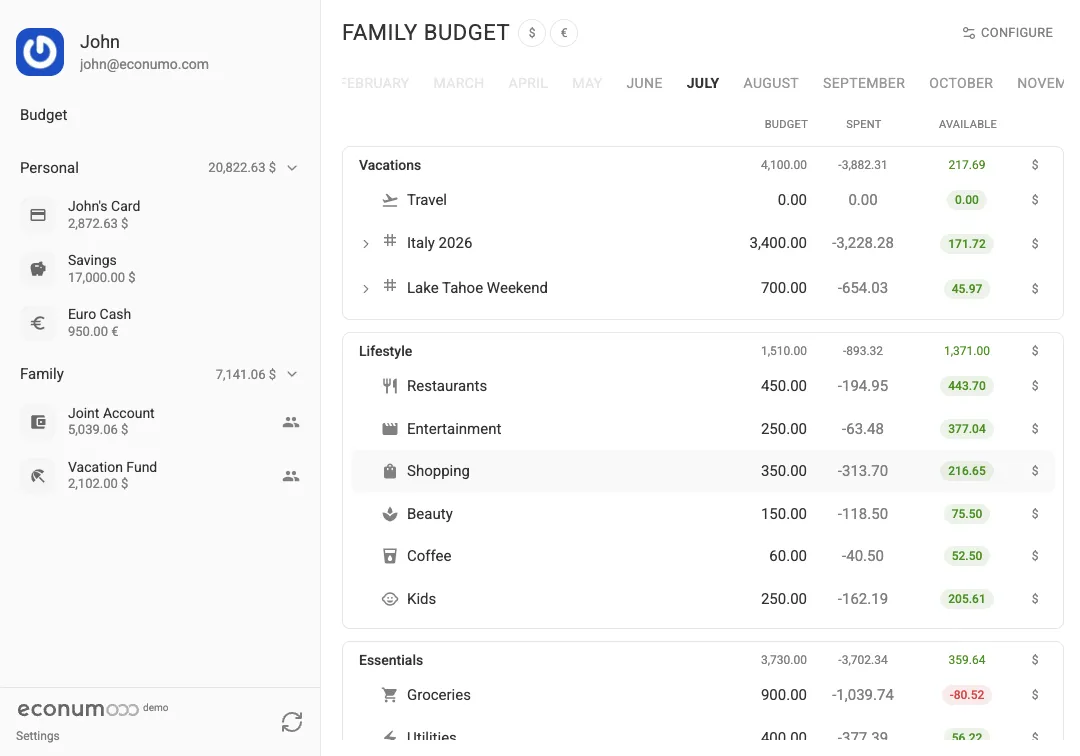
Econumo’s budget view: envelopes grouped into folders, with per-envelope limits.
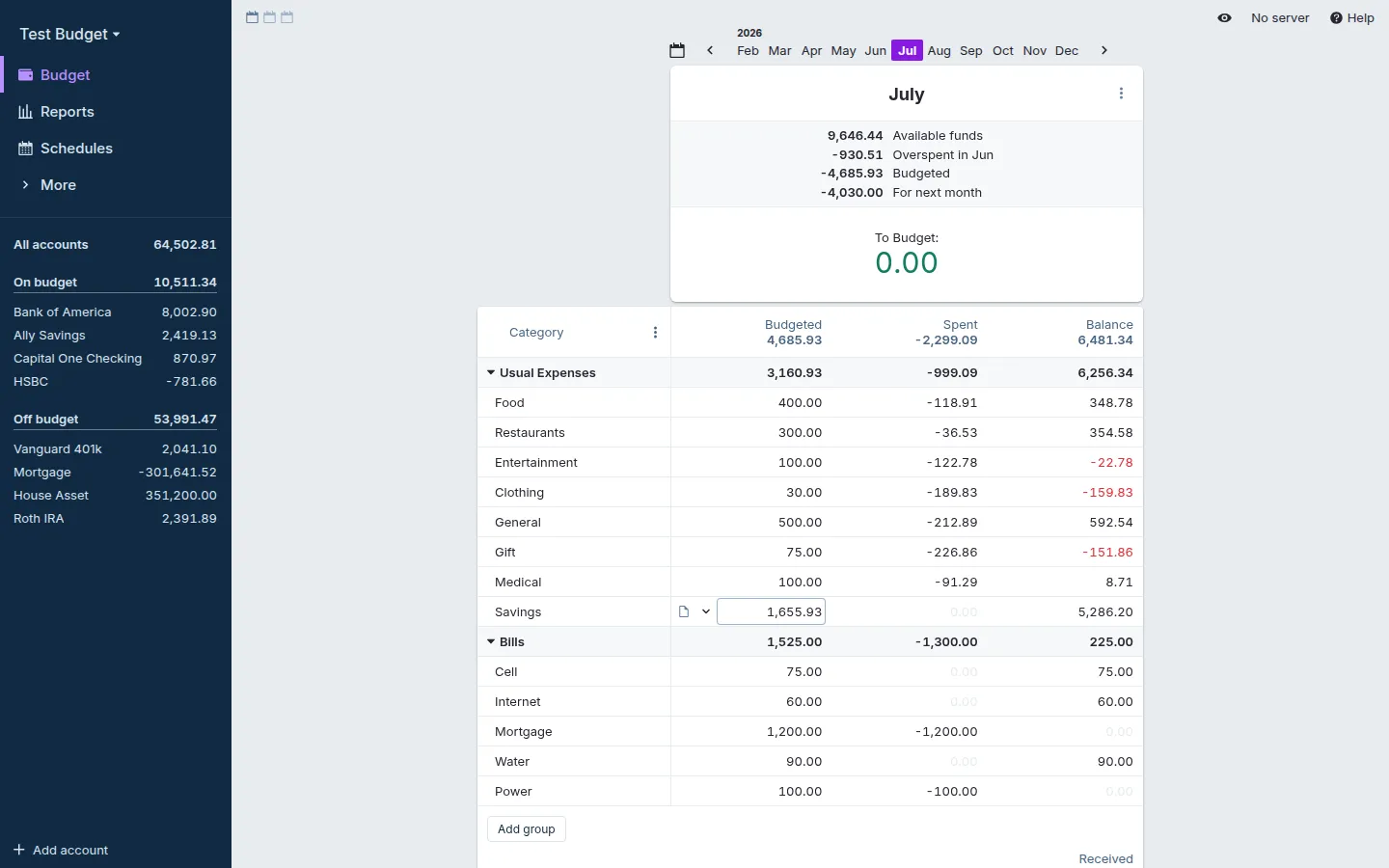
Actual Budget’s budget view: categories with Budgeted / Spent / Balance columns and a “To Budget” figure. Screenshot from the official public demo.
The layouts are close cousins. The meaningful differences are elsewhere.
Multi-currency — Econumo’s clearest advantage #
This is the single biggest functional gap between the two, and it is not a close call.
Actual Budget does not support multi-currency. Its own documentation states that the software is “currency agnostic and does not support multi-currency”. The only documented approach is a manual workaround: hold separate accounts per currency and convert amounts yourself using rule templating, which is itself an experimental feature. There is no per-account currency field, no automatic exchange-rate updates and no multi-currency reporting.
The request is the most-upvoted issue in the repository — #1132, opened in June 2023 with 328 upvotes — and discussion was still active in April 2026 over how to model the data. It does not appear on the 2026 roadmap. What has shipped so far is cosmetic: v26.1.0 added currency symbols to the budget view, and v26.7.0 added three more symbols to the list.
Econumo supports multiple currencies natively. Each account has its own fixed currency; cross-currency transfers record both amounts; and the budget converts everything into a single currency so the totals reconcile. See Multi-Currency for how it works.
If you hold money in more than one currency — expats, cross-border families, anyone paid in a currency they do not spend — this alone likely decides it.
Family sharing — built in vs bolted on #
Both support more than one person, with very different setup costs.
Econumo has sharing as a first-class concept. You connect to another user by invitation, then choose an access level per account and per budget. Nothing to install, nothing to configure.
Actual Budget supports multi-user, but the documentation requires you to run an external OpenID Connect provider — Authelia, Authentik, Keycloak or similar — next to your Actual server. Without OIDC, the server is protected by one shared password, so everyone in the household shares an identity. Two roles exist (Basic and Admin), and budget owners grant per-budget access.
For a technical user who already runs an identity provider, this is fine, even preferable. For a couple who want a shared budget on a Raspberry Pi, standing up Keycloak is a real barrier.
Bank synchronisation — Actual Budget’s clearest advantage #
Here the advantage runs the other way, decisively.
Actual Budget supports four active bank-sync providers, covering much of the world:
| Provider | Region | Note |
|---|---|---|
| SimpleFIN Bridge | North America | Paid third-party service |
| Enable Banking | Europe | Added 2026 |
| Akahu | New Zealand | Added v26.7.0, experimental |
| Pluggy.ai | Brazil |
One caveat if you are in the EU: the older GoCardless integration is no longer accepting new accounts, so new European users are routed to the newer Enable Banking integration. Every provider also requires you to register your own API credentials — Actual brokers nothing on your behalf.
Econumo has no automatic bank import. This is an explicit product decision rather than a missing feature: the FAQ states that automated import is not a priority, on the view that manual entry builds a stronger habit of attention to spending. CSV import and export and the REST API are the supported routes for bulk data.
If automatic transaction import is non-negotiable for you, choose Actual Budget.
Mobile #
Neither project ships a maintained native mobile app.
Actual Budget’s official mobile applications are deprecated, and the archived codebase is public; mobile parity is a stated 2026 roadmap goal, which is itself an acknowledgement of the current gap. What exists is an installable PWA, plus unofficial community clients.
Econumo is a responsive web app installable to the home screen on iPhone, Android, Mac and PC.
In practice both are “a good mobile website you can pin to your home screen”.
Data, API and automation #
| Econumo | Actual Budget | |
|---|---|---|
| Import formats | CSV | CSV, QIF, OFX, QFX, CAMT.053 |
| YNAB migration | ❌ | ✅ YNAB4 and nYNAB importers |
| Export | CSV | CSV, full local data file |
| REST API | ✅ OpenAPI / Swagger UI | ✅ Node.js API library |
| CLI | ❌ | ✅ Stable since v26.7.0 |
| Rules engine | ❌ | ✅ Conditions, actions, templating |
| End-to-end encryption | ❌ | ✅ Optional |
Actual Budget is substantially stronger on data portability and automation. Its rules engine, importers and optional end-to-end encryption are mature, and its YNAB importers make migration off YNAB genuinely straightforward.
Econumo’s API is fully documented via Swagger — you can browse it on the API docs — but there is no CLI and no rules engine today.
Running it #
| Econumo | Actual Budget | |
|---|---|---|
| Stack | Go, single static binary | TypeScript on Node.js ≥ 22 |
| Image | Distroless Docker image | Docker image |
| Database | SQLite or PostgreSQL | SQLite |
| Memory footprint | ~10 MB | Higher (Node runtime) |
| Architecture | Server-rendered API + web app | Local-first with sync server |
| Desktop builds | — | Microsoft Store, Flathub |
Econumo ships as one self-contained Go binary in a distroless image that serves both the API and the web app, runs migrations on boot and uses about 10 MB of RAM. On a small VPS or a Raspberry Pi alongside other services, that is a meaningful difference.
Actual Budget’s local-first architecture is the more interesting design: your data lives on your device and syncs through your server, so the app keeps working fully offline and syncs when it reconnects. Econumo requires a reachable server.
Which should you choose? #
Choose Actual Budget if:
- You budget in a single currency
- Automatic bank synchronisation matters to you
- You want end-to-end encryption or offline-first operation
- You are migrating from YNAB and want an importer
- Community size, contributor count and ecosystem maturity are decisive
- You want a rules engine and CLI for automation
Choose Econumo if:
- You budget across multiple currencies
- You want family sharing that works out of the box, without running an identity provider
- You want a hosted account for a single $29.99 payment rather than self-hosting or a subscription
- You are running on constrained hardware and want a ~10 MB single binary
- You prefer deliberate manual entry to automatic import
Both are MIT-licensed and both let you export your data, so neither choice locks you in. If you are undecided, a free Econumo trial and the Actual Budget demo both run in the browser with no signup.
Frequently asked questions #
Is Actual Budget free? #
Yes — MIT-licensed and completely free, with no paid tier and no first-party hosted plan. Its hosting partner PikaPods charges about $1.50 per month.
Does Actual Budget support multiple currencies? #
No. The official documentation states it is currency agnostic and does not support multi-currency. Only a manual workaround is documented. The request has been the most-upvoted issue in the project since 2023 and is not on the 2026 roadmap.
Can two people share a budget in Actual Budget? #
Yes, but it requires configuring an external OpenID Connect provider such as Authelia, Authentik or Keycloak. Without OIDC the server uses a single shared password. Econumo has invitation-based sharing with per-item access levels built in.
Which is better for budgeting in more than one currency? #
Econumo. Each account has its own currency, cross-currency transfers record both amounts, and the budget converts everything to one currency. Actual Budget does not support multi-currency at all.
Does Econumo have automatic bank synchronisation? #
No. Econumo is manual-entry first, with CSV import and a REST API for bulk data. Actual Budget is clearly stronger here.
Last verified 19 July 2026 against the GitHub API and each project’s official documentation. Star counts, release counts and prices change — if you spot something out of date, let us know.