Yes, you can absolutely get a collection removed from your credit report. The most common ways are by disputing errors, forcing the collector to validate the debt, or negotiating a “pay-for-delete” deal. And thanks to some recent industry changes, it’s gotten easier to remove certain debts, especially medical collections.
But first, you have to understand what you’re up against.
How Collections Really Affect Your Credit Score #
That sinking feeling when a “collection” account suddenly appears on your credit report is real. It’s not just another late payment; it’s a bright, flashing signal to lenders that your original creditor gave up on you and sold your debt to a collection agency. In the lending world, that’s a serious red flag.
Lenders see collections as a major sign of risk. It tells them you’ve had trouble paying your bills in the past, which makes them think twice about giving you new credit. An open collection can get you denied for a mortgage, a car loan, or even a basic credit card. If you do get approved, you’ll almost certainly be stuck with a much higher interest rate, costing you a ton of money over time.
The Anatomy of a Credit Score Drop #
Your payment history is the single biggest piece of your credit score puzzle—it accounts for 35% of your FICO® Score. A collection account hits this category like a wrecking ball.
Think about it: for an account to even get to collections, you likely missed several payments, which already hurt your score. The collection itself then adds a fresh, severe negative mark that can haunt your report for up to seven years.
A single collection can slash your score by 50 to 100 points, sometimes more if you had a great score to begin with. This is exactly why figuring out how to remove collections is one of the most powerful things you can do for your financial health. If you’re looking for other ways to bounce back, check out our guide on how to improve your credit score.
Shifting Rules and New Opportunities #
The good news? The rules of the game are changing in your favor, especially when it comes to medical debt. The credit bureaus have started treating these types of collections with more leniency.
Here are the key changes you need to know:
- Paid Medical Collections: Once you’ve paid off a medical collection, it must be completely deleted from your credit reports. It’s gone for good.
- Small Medical Debts: Any medical collection that started with a balance under $500 is no longer allowed to be on your credit report at all.
- Grace Period for Medical Debt: New unpaid medical debts won’t show up on your credit report for a full year. This gives you plenty of time to sort out any issues with insurance or billing before it can do any damage.
These changes are making a real difference. One analysis found that between 2018 and 2022, the total number of collections on consumer reports plummeted by 33%, and the share of people with a collection dropped by 20%.
This trend clearly shows that efforts to remove collections from credit reports are working better than ever. While a collection from a credit card or personal loan is still a big deal, these new rules offer huge relief for millions of people. Knowing where you stand is the first step—it helps you pick the right strategy for your specific situation.
Finding Every Collection on Your Credit Reports #
First things first: you can’t fix what you can’t find. To get collections removed, you need a complete picture of every single one listed on your credit reports. It’s not uncommon for an old debt to pop up out of nowhere and derail your financial plans, so let’s start by uncovering exactly what you’re dealing with.
The only place you should go for this is AnnualCreditReport.com. This is the official, government-backed site where you can get your reports from the big three bureaus—Equifax, Experian, and TransUnion—absolutely free, every single week. Steer clear of other websites that dangle “free reports” but might stick you with a subscription or hidden charges.
Getting Your Official Credit Reports #
The process is pretty simple. Head over to the site, and they’ll ask for standard identity verification stuff: name, address, Social Security number, and date of birth. You’ll likely have to answer a few security questions, too, like confirming a previous address or the monthly payment on an old auto loan. It’s just to make sure you’re you.
Once you’re in, you’ll get instant online access to all three reports. My strong advice? Download and save a PDF of each one immediately. This gives you a starting point, a “before” snapshot that you can use to track your progress as you start challenging these accounts.
How to Pinpoint Collection Accounts #
With your reports in hand, it’s time to do a little digging. Each bureau’s report looks a bit different, but they all have a section for negative information. That’s your treasure map—or your minefield, depending on how you look at it. This is where collections live.
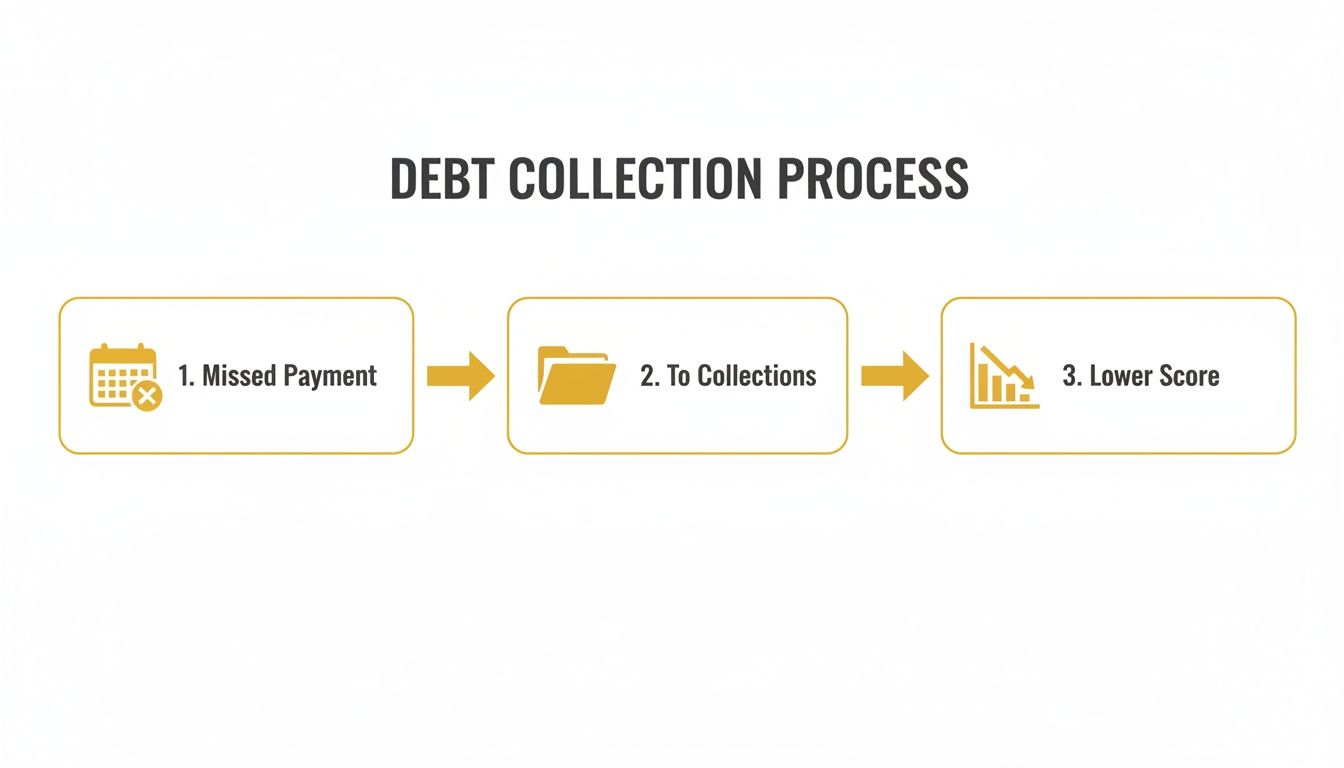
This flowchart shows just how quickly a simple missed payment can snowball into a collection and tank your credit score.
As you go through your reports, keep an eye out for company names you don’t recognize, especially if they have words like “collections” or “debt buyer” in the name. For every single collection you spot, create a master list and jot down these details:
- Collection Agency Name & Contact Info: This is who you’ll be dealing with.
- Original Creditor: The company you first owed money to (e.g., your old cell phone provider).
- Account Number: Get both the collector’s number and the original one if you can find it.
- Balance Owed: The exact amount the agency claims you owe.
- Date of First Delinquency: This one is huge. It’s the date that starts the seven-year clock for how long the collection can legally stay on your report.
Pro Tip: You’ll probably notice that the information doesn’t line up perfectly across all three reports. Don’t panic. It’s actually quite common for Experian to show an account that TransUnion doesn’t, or for the balances and dates to be slightly off. This is precisely why you must pull all three.
In fact, these inconsistencies are often your secret weapon. If an agency is reporting an incorrect balance or the wrong delinquency date, you have solid grounds for a dispute. Sometimes, their bad bookkeeping is the best tool you have for getting the negative mark wiped clean.
Using Debt Validation to Challenge Collectors #
When a debt collector first contacts you, it’s easy to feel a jolt of panic. The natural reaction is often to either ignore them or get defensive. But I’m going to let you in on a secret: this is your moment to take control.
Your most powerful first move is to make the collector prove the debt is actually yours and that they have the legal right to collect it. This isn’t just a clever tactic; it’s a right you’re given under the Fair Debt Collection Practices Act (FDCPA). It’s called debt validation, and it’s your first line of defense.
Think about it: collection accounts are often bought and sold multiple times. Along the way, paperwork gets lost and details get fuzzy. By simply demanding proof, you put the burden squarely on the collector’s shoulders. If they can’t deliver, they can’t collect.
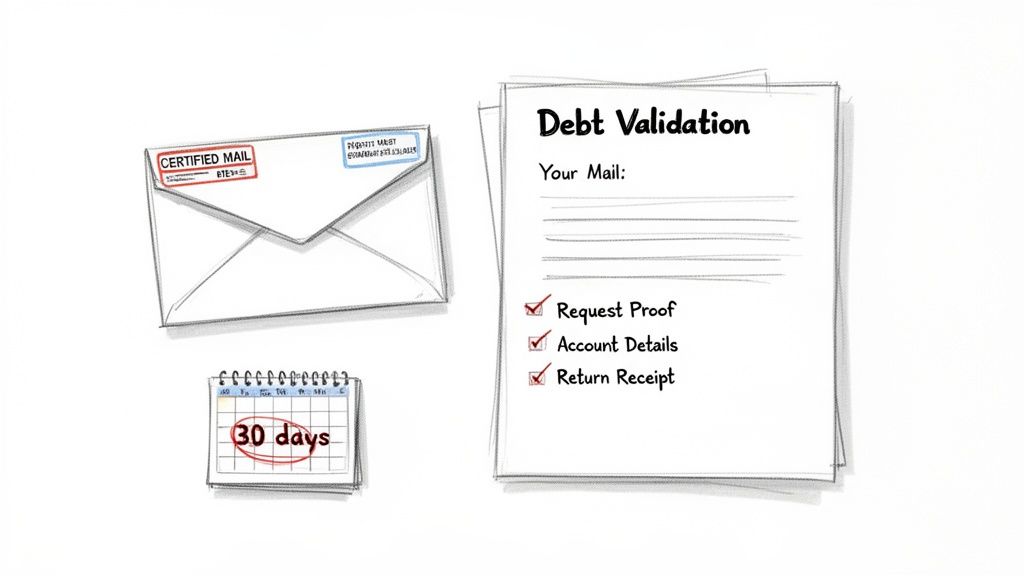
Why the First 30 Days Are Crucial #
Here’s where it gets really important. The FDCPA requires a collector to send you a written notice within five days of their first contact. As soon as you get that notice, a 30-day clock starts ticking.
This 30-day window is your golden opportunity. If you send a debt validation letter within this period, the collector is legally required to stop all collection activities. That means no more phone calls, no more letters, and—most importantly—no reporting to the credit bureaus until they can prove their case. Missing this window is one of the biggest mistakes people make.
Sending Your Debt Validation Letter #
Your letter doesn’t need to be filled with complicated legal jargon. You just need to clearly state that you’re disputing the debt and requesting validation.
Now, here’s a tip I can’t stress enough: always send this letter via certified mail with a return receipt requested. Yes, it costs a few extra bucks, but it creates an undeniable paper trail. You’ll have a legal document proving exactly when you sent the letter and when they received it. This is your insurance policy if a collector later tries to claim they never got your request.
Never, ever try to handle a dispute over the phone. A phone call is just your word against theirs. A certified letter is concrete evidence that will hold up if you need to take further action.
What Happens When You Request Validation #
Once the collector gets your letter, the ball is officially in their court. They can’t just send you a simple account statement; they have to provide specific documentation, like:
- Proof that you are the person responsible for the debt.
- The name and address of the original creditor.
- Documentation showing they have the legal authority to collect the debt.
- The original account number and the amount owed.
The best-case scenario? They don’t have the paperwork. This happens far more often than you’d think, especially with older debts that have been passed around. If they can’t validate the debt, they are legally obligated to stop all collection efforts and must ask the credit bureaus to remove the collection from your credit report.
If they do send back documents, look them over with a fine-tooth comb. Compare every detail to your own records. A wrong date, an incorrect balance, or a name that isn’t yours can all be grounds to dispute the entry directly with the credit bureaus. This brings up an important distinction.
Debt Validation vs. Credit Bureau Dispute: What Is The Difference? #
It’s really easy to get these two terms mixed up, but they’re completely different tools in your credit repair toolkit. Knowing which one to use, and when, is the key to getting results.
Here’s a simple breakdown:
| Action | Who You Contact | Purpose | When to Use It |
|---|---|---|---|
| Debt Validation | The collection agency directly | To make the collector prove they have the legal right to collect the debt and that the debt is accurate. | As your first step, ideally within 30 days of the collector’s initial contact. |
| Credit Dispute | The credit bureaus (Equifax, Experian, TransUnion) | To correct inaccurate information already on your credit report, like a wrong balance or an account that isn’t yours. | After attempting debt validation or if you find a clear error on your credit report. |
By starting with debt validation, you challenge the collection at its source. This simple but powerful step can stop a collector in their tracks and is often the quickest path to getting that negative mark removed for good.
Disputing Inaccurate Collections With The Credit Bureaus #
While sending a debt validation letter to the collector is a fantastic first step, sometimes the collector isn’t the problem. The error might actually be on your credit report itself, maintained by the “big three” credit bureaus: Equifax, Experian, and TransUnion.
When that’s the case, you need to shift your focus from the collection agency directly to the bureaus. Thanks to the Fair Credit Reporting Act (FCRA), you have the legal right to an accurate credit report. If you spot something that’s not right, you can—and should—dispute it.
Building a Strong Case for Your Dispute #
You can’t just dispute a collection because it’s a hassle. You need a solid, factual reason. The good news? Mistakes are far more common than you’d think. A successful dispute is built on hard evidence, not just wishful thinking.
Here are some of the most powerful reasons to file a dispute:
- This Isn’t My Debt: This is a big one. It could be a simple mix-up with someone who has a similar name, or it could be a clear sign of identity theft.
- The Balance Is Wrong: The collector might be reporting an inflated amount. This often happens when they tack on questionable fees or interest charges that weren’t part of the original agreement.
- The Dates Are Off: Pay close attention to the “Date of First Delinquency.” This date is what starts the seven-year clock for how long the collection can stay on your report. An incorrect date can illegally extend that timeline.
- It’s a Duplicate Account: I’ve seen this happen where both the original creditor and the collection agency report the same debt. This makes it look like you have two separate negative marks, which can really drag your score down.
If any of these sound familiar, you have legitimate grounds to challenge the entry and work to remove the collection from your credit report.
How to Formally File Your Dispute #
Your best move is to file your dispute in writing and send it via certified mail with a return receipt requested—just like you did with the debt validation letter. I know the online dispute portals are quick and easy, but a physical letter creates an undeniable paper trail and lets you package all your evidence together.
Keep your dispute letter short and to the point. Clearly state your name and address, identify the specific account you’re disputing (include the account number), and explain exactly why it’s inaccurate. State what you want the outcome to be—either correcting the specific error or deleting the account entirely.
Crucial Tip: A dispute without proof is just an opinion. Always, always include copies of any documents that back up your claim. This could be anything from bank statements or the debt validation response you got from the collector to screenshots or a copy of your credit report with the error highlighted.
Make copies of everything. Never send your originals. Your goal is to hand the credit bureau investigator an open-and-shut case that’s impossible to ignore.
What to Expect After You Send the Letter #
Once a credit bureau receives your dispute, the clock starts ticking. They are legally required to investigate your claim, usually within 30 to 45 days. They’ll reach out to the collection agency that furnished the information and ask them to prove it’s accurate.
If the collection agency can’t verify the debt’s accuracy, or if they just don’t bother responding in time, the credit bureau is required by law to either correct the information or delete the account from your file.
When the investigation is over, you’ll get a letter in the mail with the results. You’ll see one of three outcomes:
- Deleted: This is the home run. The bureau couldn’t verify the information and has wiped the collection account from your credit report completely.
- Corrected: A partial win. The bureau agreed something was wrong (like the balance or a date) and updated it. The account itself, however, will remain.
- Verified: The collection agency provided some form of “proof” that the information was accurate, so the negative mark stays on your report as is.
If the bureau verifies the collection but you’re certain it’s wrong, don’t lose hope. You can always file a new dispute if you have new evidence. You also have the right to add a 100-word statement to your credit file, giving you a chance to explain your side of the story to anyone who pulls your credit.
Negotiating a Pay-For-Delete Agreement on Valid Debts #
So, you’ve sent the letters and done your homework, but the collection agency came back and verified the debt is legitimate. It’s easy to feel like you’ve hit a dead end, but you haven’t. This is the moment where negotiation becomes your most powerful tool to remove collections from your credit report.
Even when a debt is 100% valid, you still hold some important cards. Collection agencies are businesses, plain and simple. Their goal is to recover money—any money. They often buy old debts for just pennies on the dollar, which means they can turn a profit even if you pay a fraction of the original amount.
This is where you can introduce a powerful strategy: the pay-for-delete agreement.
It’s a straightforward deal. You offer to pay an agreed-upon amount, and in exchange for your payment, the collector promises to completely remove the negative collection account from all three of your credit reports. It’s a win-win.
Understanding Your Leverage in Negotiations #
It’s tough not to feel like you’re on the back foot when talking to a debt collector, but knowing how their business works can completely change the dynamic.
Think about it this way: on average, debt collectors only manage to recover about 20 cents for every dollar of debt they try to collect. For debts that are older or have a messy history, that success rate can drop to 10% or even less.
This is your leverage. They would much rather get something from you right now than risk getting nothing at all down the road. Your offer to pay is a guaranteed win for them. With nearly one in five people having some kind of debt in collections, collectors are highly motivated to close out accounts and move on. You can dig into the numbers in recent research on the surge of debt collection lawsuits.
Starting the Conversation and Making an Offer #
When you’re ready to make the call, the key is to stay calm and professional. Stick to the facts. You can start by saying you’re calling to resolve the account, but it’s a good practice to avoid explicitly saying, “I admit this debt is mine.” It’s a subtle legal point, but an important one.
Your first offer should be low. A good starting point is around 30% of the total balance. For a $1,000 debt, you might open with an offer of $300. They’ll almost certainly counter, and that’s when the real negotiation begins. Most people can successfully settle debts for somewhere between 40% and 60% of what they owe.
A few tips for the call:
- Jot Down a Script: Knowing what you want to say ahead of time helps you stay on track and not get flustered.
- Don’t Rush: You don’t have to accept their first counteroffer. It’s perfectly fine to say you need to think about it and will call them back.
- Offer a Lump Sum: Collectors love a single, one-time payment. If you have the cash saved up, use that as your main bargaining chip—it’s much more appealing to them than a payment plan.
Crucial Rule of Negotiation: Never, ever send a single penny until you have the entire agreement in writing. A verbal promise from a collector over the phone is completely unenforceable.
Insist that the agency mails or emails you a formal agreement on their company letterhead. This document absolutely must state that in exchange for your payment, they will delete the account listing from Equifax, Experian, and TransUnion. No vague language—it needs to be explicit.
Finalizing the Deal and Following Up #
Once you have the written agreement in hand and have double-checked that all the terms are correct, it’s time to pay. Never give a debt collector your bank account details or a debit card number.
Instead, use a payment method that gives you a clear paper trail without giving them ongoing access to your money. A cashier’s check or a money order is perfect for this. This one step protects you from any “accidental” or unauthorized withdrawals later.
After you’ve sent the payment, you’re almost done. Now, you need to monitor your credit reports for the next 30 to 60 days. The collection account should vanish. If it’s still there after two months, you have the written agreement and your proof of payment to file a powerful dispute directly with the credit bureaus.
If you’re trying to build up the funds for a settlement, our guide on how to pay off debt faster has some great strategies. By turning a valid debt into a successful pay-for-delete, you’re not just paying something off—you’re actively clearing your credit history and taking back control.
Common Questions About Removing Collections #
Diving into the world of credit repair can feel a bit like learning a new language. Even when you’ve got the basic strategies down, questions always seem to pop up. Let’s walk through some of the most common ones I hear, so you can move forward with total confidence.
How Long Does A Collection Stay On My Credit Report If I Do Nothing? #
If you just leave it alone, a collection account will hang around on your credit report for seven years. That clock starts ticking from the date you first missed a payment on the original debt, not from when the collector bought it.
Here’s the thing: just paying off the collection doesn’t make it disappear. It also doesn’t reset that seven-year timeline. While its sting will lessen over the years, that collection can still be a major red flag for lenders until it finally falls off your report. This is exactly why being proactive and working to remove collections from your credit report is a much more powerful move than simply waiting it out.
Are Medical Collections Handled Differently Than Other Debts? #
Yes, they absolutely are—and this is a huge win for consumers. The credit bureaus finally recognized that medical debt is usually unplanned and doesn’t really reflect how you handle your finances. Because of this, the rules are much more forgiving for medical collections compared to things like old credit card bills or personal loans.
Here are the key changes that have brought a lot of relief:
- Small Balances Gone: Any medical collection with an original balance under $500 has been completely wiped from consumer credit reports.
- Paid Medical Debts Vanish: Once you pay off a medical collection, it must be deleted from your credit file. It’s gone for good.
- A One-Year Grace Period: New, unpaid medical debt can’t even show up on your credit report for a full year. This gives you plenty of time to sort things out with insurance or the hospital billing department.
This one policy change was a game-changer. It led to nearly 70% of all medical collection tradelines being removed from credit reports, boosting the scores of millions of people almost overnight.
Just remember, these protections are only for medical debt. That old phone bill or personal loan in collections doesn’t get the same treatment, which makes negotiation and disputes for those accounts even more critical.
Should I Hire A Credit Repair Company To Remove Collections For Me? #
When you’re feeling overwhelmed, handing the problem off to someone else sounds tempting. But it’s really important to know that credit repair companies don’t have a magic wand or secret industry tricks. They use the exact same methods we’ve covered in this guide—debt validation, disputes, and negotiation—all of which you are legally allowed to do yourself for free.
The main difference is they charge you a monthly fee for their service. Some people might find the convenience worth it, but doing it yourself has some serious perks. You save money, you stay in complete control of the process, and you learn financial skills that will benefit you for the rest of your life.
If you’re already trying to manage your money to pay off debts, adding another monthly bill for a credit repair company can be counterproductive. Learning how to stick to a budget is the first step toward freeing up cash you could use for a settlement offer. If you still feel you need help, look into a reputable non-profit credit counseling agency. They’re a much more trustworthy and affordable alternative to most for-profit companies.
Ready to take full control of your financial picture? Econumo provides the tools you need to build a budget, track your spending, and accelerate your debt-payoff journey. Manage your money with clarity and confidence. Try our live demo or join the waiting list today!