Building a solid financial foundation starts with one simple, yet powerful, step: knowing exactly where your money goes. For many individuals, couples, and families, gaining a complete picture of spending feels overwhelming. Small, untracked purchases and overlooked recurring bills can easily lead to budget overruns, strained conversations about money, and missed savings goals. This is where a comprehensive list of household expenses becomes an indispensable tool, transforming financial chaos into clarity.
This guide is designed to be your definitive roadmap. We will break down every common spending category, from the non-negotiable roof over your head to the discretionary subscriptions that quietly add up over time. You won’t just get a simple checklist; you’ll gain a deeper understanding of how each expense fits into your overall financial health. We’ll explore fixed costs, variable spending, and the “just-in-case” funds that provide a crucial safety net.
More importantly, we will provide actionable tips for tracking, managing, and reducing these costs. We’ll offer practical examples, including how to map these items to a joint account or handle multi-currency workflows in a tool like Econumo for seamless collaboration with a partner. By the end of this guide, you won’t just have a list; you’ll have a clear, actionable plan to take control of your finances, align on shared goals, and build a more secure future. Let’s dive in and categorize your spending for maximum impact.
1. Housing & Rent/Mortgage Payments #
As the cornerstone of any budget, housing is almost always the largest item on a list of household expenses. This category covers your primary shelter costs, whether you are paying monthly rent to a landlord or making mortgage payments to a lender. It’s a foundational expense that directly impacts your financial stability and the budget available for all other spending.
What It Includes #
Beyond the base payment, this category often includes other essential costs that are easy to overlook if not tracked carefully.
- Principal & Interest: The core components of a mortgage payment.
- Property Taxes: Annual or semi-annual taxes paid to local governments.
- Homeowners Insurance: Required by lenders to protect the property.
- Renters Insurance: Protects your personal belongings within a rental unit.
- HOA/Condo Fees: Monthly or annual fees for community maintenance and amenities.
Budgeting Priority & Sample Costs #
Housing is a high-priority, fixed expense. Financial experts often recommend that total housing costs should not exceed 30% of your gross monthly income.
- Urban Renters: A monthly rent payment could be around $1,500.
- Suburban Homeowners: A typical mortgage, including taxes and insurance (PITI), might be $2,200.
- Couples: A shared housing cost of $2,500 might be split evenly at $1,250 each.
Key Insight: Tracking housing isn’t just about the main payment. Separating property taxes, insurance, and maintenance in your budget reveals the true cost of your home and prevents surprise expenses from derailing your finances.
How to Track and Reduce Costs with Econumo #
Properly managing this significant expense is crucial, especially for couples, families, and expats.
- Automate Fixed Costs: Set up a recurring transaction in Econumo for your rent or mortgage. This ensures it’s always accounted for without manual entry.
- Use Sub-Categories: Create separate line items for “Mortgage,” “Property Tax,” and “HOA Fees.” This provides clarity on where your money is going and helps you anticipate annual increases.
- Collaborate with Partners: Use Econumo’s multi-user feature to map housing expenses to a joint account. This gives both partners full visibility and shared responsibility.
- Manage Multiple Currencies: For expats paying a mortgage back home while earning in a different currency, Econumo’s multi-currency workflow simplifies tracking and conversion.
By breaking down your largest expense into manageable parts, you gain greater control. For more ideas on managing this cost, you can explore our guide on how to reduce monthly expenses.
2. Utilities & Internet Services #
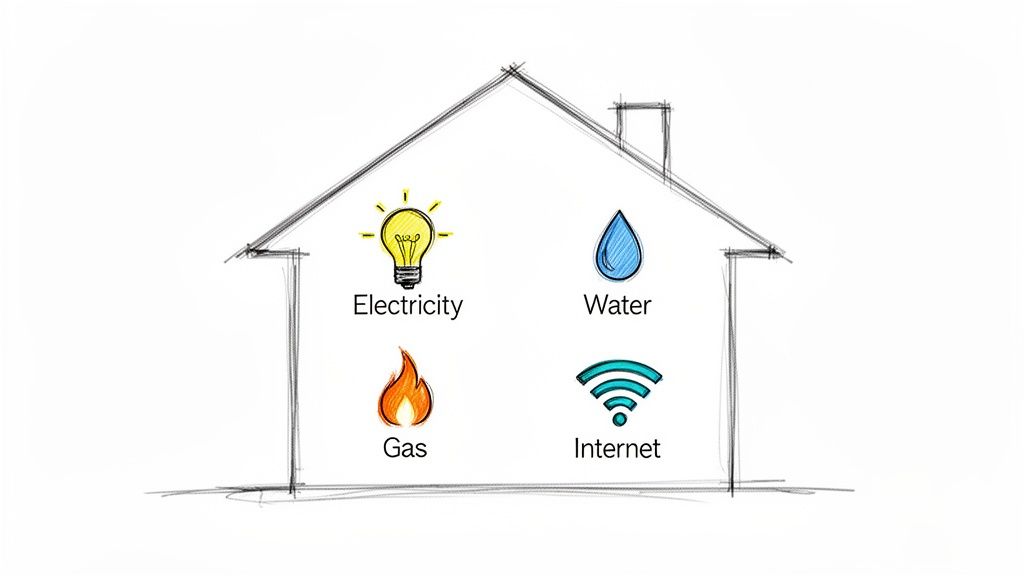
After housing, utilities and internet services are essential recurring costs that keep a modern household running. This category on the list of household expenses covers everything from the electricity powering your lights to the internet connecting you to the world. These expenses can fluctuate with seasons and usage, making them critical to monitor for savings opportunities.
What It Includes #
This group of expenses is a collection of several distinct services, each with its own bill and payment schedule. Tracking them individually provides the clearest picture of your household’s consumption habits.
- Electricity: Powering lights, appliances, and electronics.
- Gas/Heating: For heating, cooking, and hot water, with costs often peaking in winter.
- Water & Sewage: Covers water usage and wastewater processing.
- Trash & Recycling: Fees for municipal or private waste collection services.
- Internet & Phone: Your connection to the digital world, including home internet and mobile phone plans.
Budgeting Priority & Sample Costs #
Utilities are a high-priority, variable expense. While necessary, the amounts can change month-to-month based on your usage, making diligent tracking crucial for budget accuracy.
- Apartment Dwellers: A monthly electricity bill might be around $90.
- Family Home: A combined utility cost (gas, water, electricity) could average $250.
- Digital Nomads: A typical internet and phone service bundle might cost $100.
Key Insight: Unlike a fixed mortgage, utilities offer a direct opportunity to save money through behavior change. Tracking consumption patterns month-over-month allows you to see the financial impact of turning down the thermostat or upgrading to energy-efficient appliances.
How to Track and Reduce Costs with Econumo #
Managing these variable expenses is key to creating a predictable budget, especially for families and couples sharing costs.
- Categorize Each Service: In Econumo, create separate categories for “Electricity,” “Water,” and “Internet.” This prevents lumping them together and helps you spot which specific utility is driving up costs.
- Set Budget Alerts: Use budget alerts to notify you if your electricity bill, for instance, is unusually high one month. This serves as an early warning to investigate potential issues or adjust habits.
- Track Seasonality: Compare your heating bill from this January to last January. Econumo’s historical data makes it easy to identify seasonal trends and budget more accurately for peak months.
- Manage Shared Bills: For couples, one partner can be assigned the “Internet Bill” payment in Econumo, but the expense can be mapped to a joint account so both partners have full visibility.
By treating each utility as its own line item, you can gain control over these fluctuating costs. To integrate these expenses effectively, explore our guide on how to create a household budget.
3. Groceries & Food Shopping #
After housing and utilities, groceries often represent the most significant and variable part of a list of household expenses. This category includes all food and related supplies purchased for consumption at home. Because it’s a recurring expense with high variability, careful tracking is essential for identifying spending patterns and unlocking significant savings.

What It Includes #
This category goes beyond just meal ingredients and covers everything you buy at the supermarket or farmers’ market.
- Fresh Produce: Fruits and vegetables.
- Proteins: Meat, poultry, fish, and plant-based alternatives.
- Pantry Staples: Grains, pasta, canned goods, spices, and oils.
- Dairy & Beverages: Milk, cheese, yogurt, coffee, and juices.
- Household Supplies: Often purchased with groceries, like cleaning products and paper goods.
Budgeting Priority & Sample Costs #
Groceries are a high-priority, variable expense. While essential, the amount you spend can be controlled through conscious planning and shopping habits.
- Budgeting Family: A family of four might budget $600 per month.
- Organic/Specialty Focus: A couple prioritizing organic foods could spend $800.
- Warehouse Shoppers: Bulk buying can reduce per-item costs by 20-30%.
Key Insight: The power in tracking groceries lies in the details. Moving from a single “Groceries” line item to sub-categories like “Produce,” “Protein,” and “Pantry” reveals exactly where your money goes, turning a vague expense into a series of manageable choices.
How to Track and Reduce Costs with Econumo #
Managing this variable expense effectively is key to freeing up cash for other financial goals.
- Log Every Receipt: Use Econumo’s manual entry to log each grocery bill. This builds mindfulness around your spending habits and helps you stick to a weekly or monthly budget.
- Create Detailed Sub-Categories: Break down your “Food” category into “Groceries,” “Dining Out,” and “Coffee Shops.” This prevents food spending from becoming a single, overwhelming number.
- Track by Store: When logging an expense, add the store name in the description. Over time, you can run reports to see which stores offer the best prices for your staple items.
- Set Realistic Budgets: Use your historical data in Econumo to set an achievable weekly or monthly grocery budget. Include a small buffer for stocking up on sale items or making occasional bulk purchases.
4. Transportation & Vehicle Expenses #
After housing and food, transportation is often one of the largest and most variable items on a list of household expenses. This category encompasses everything from owning a vehicle to using public transit or ride-sharing services. How you get around directly impacts your monthly budget, making it a critical area to track for financial health, especially for families with multiple vehicles or commuters in urban areas.
What It Includes #
This category is more than just a car payment; it includes a wide range of variable and fixed costs that can add up quickly if not monitored.
- Vehicle Payments: The monthly loan or lease payment for a car.
- Fuel: Gasoline or electricity costs, which fluctuate with usage and market prices.
- Insurance: Mandatory monthly or semi-annual premiums for auto coverage.
- Maintenance & Repairs: Both routine (oil changes, tires) and unexpected repairs.
- Public Transit & Ride-Sharing: Costs for buses, trains, subways, Uber, or Lyft.
- Annual Fees: Vehicle registration, taxes, and inspection fees.
Budgeting Priority & Sample Costs #
Transportation is a high-priority, mixed expense, combining fixed costs like insurance with variable costs like fuel. Its total can vary significantly based on lifestyle and location.
- Single Car Owner: A car payment, fuel, and insurance could total $500 - $750 per month.
- Urban Commuter: Relying on public transit might cost $100 - $150 monthly.
- Family with Two Vehicles: Total expenses could easily reach $800 - $1,200 per month.
Key Insight: The true cost of owning a vehicle is far more than the monthly payment. Budgeting for a separate “maintenance fund” by setting aside $50-$100 each month prevents large, unexpected repair bills from becoming a financial emergency.
How to Track and Reduce Costs with Econumo #
Managing transportation costs, particularly for couples and expats with complex needs, requires detailed tracking and a clear overview.
- Create Vehicle-Specific Categories: In Econumo, create a parent category “Transportation” with sub-categories like “Car 1 Fuel,” “Car 2 Insurance,” and “Public Transit.” This helps identify which vehicle costs more.
- Automate Fixed Payments: Set up recurring transactions for your car payment, insurance premium, and annual registration fee so they are never missed.
- Track Variable Spending: Manually log every fuel purchase and repair bill. This reveals consumption patterns and helps you correlate mileage with fuel costs.
- Manage Joint Car Expenses: For couples sharing a vehicle, use Econumo’s multi-user feature to map all related expenses to a joint account, ensuring both partners see the full cost.
- Handle Multi-Currency Needs: If you’re an expat paying a car loan in your home currency while buying fuel locally, Econumo’s multi-currency workflow simplifies tracking and provides an accurate financial picture.
5. Insurance Premiums (Health, Auto, Home) #
Insurance is a protective layer in your financial plan, shielding you from catastrophic costs that could derail your long-term goals. This category on a list of household expenses includes all the premiums you pay for health, auto, home, life, and other forms of coverage. While it can feel like you’re paying for something you hope never to use, these regular payments provide critical financial security.
What It Includes #
This category consolidates all your risk management payments into one trackable group. It’s important to separate them to understand your total protection costs.
- Health Insurance: Monthly premiums for medical, dental, or vision coverage.
- Auto Insurance: Required coverage for vehicles, paid monthly or semi-annually.
- Homeowners/Renters Insurance: Protects your property and personal belongings.
- Life Insurance: Provides financial support for dependents in case of death.
- Disability Insurance: Replaces a portion of your income if you’re unable to work.
Budgeting Priority & Sample Costs #
Insurance is a high-priority, fixed expense. Neglecting these payments can lead to lapsed coverage, leaving you financially vulnerable.
- Individual: Monthly health insurance might be $350, with an additional $150 for auto insurance.
- Families: A comprehensive bundle could total $600 per month, covering health, two cars, and a home.
- Couples: A shared cost of $450 might cover two life insurance policies and renters insurance.
Key Insight: Don’t just “set and forget” your insurance. Review policies annually to ensure your coverage still meets your needs and to shop for better rates. Loyalty doesn’t always equal savings, and a competitor may offer the same protection for less.
How to Track and Reduce Costs with Econumo #
Managing multiple policies requires clear organization, especially for families and couples coordinating coverage.
- Automate Payments: Schedule recurring transactions in Econumo for each premium. Use the “Notes” feature to add policy numbers and renewal dates for quick reference.
- Create Specific Categories: Instead of a single “Insurance” category, create sub-categories like “Health Insurance,” “Car Insurance,” and “Life Insurance” for granular tracking.
- Compare and Bundle: Use your spending data in Econumo to see your total annual insurance cost. This figure can motivate you to shop around for quotes or ask your current provider about bundling discounts.
- Assign and Share: Assign specific insurance bills to individual or joint accounts. This helps couples clarify who is responsible for which payment while maintaining shared visibility.
6. Healthcare & Medical Expenses #
While often unpredictable, healthcare is a critical item on any comprehensive list of household expenses. This category covers all costs related to maintaining your physical and mental well-being, from routine check-ups to unexpected medical events. Since these costs can be highly variable, proactive budgeting is essential for financial security, especially for families.
What It Includes #
This category goes beyond just insurance premiums to include all out-of-pocket costs associated with your family’s health.
- Doctor & Specialist Visits: Co-pays and fees for general practitioners, specialists, and consultants.
- Prescription Medications: Costs for both one-time and recurring medications.
- Dental & Vision Care: Routine cleanings, fillings, eye exams, glasses, and contacts.
- Mental Health Services: Therapy sessions, counseling, and related treatments.
- Uncovered Procedures: Any medical service or procedure not fully covered by your insurance plan.
Budgeting Priority & Sample Costs #
Healthcare is a high-priority, variable expense. Planning for both predictable and unpredictable costs is key.
- Doctor Visit Co-pay: A typical co-pay might range from $50 to $200.
- Monthly Prescriptions: Costs can vary widely, from $100 to over $500 depending on the medication.
- Family Budgeting: A family might budget $200 to $400 monthly for routine healthcare needs.
Key Insight: Tracking healthcare spending isn’t just about paying bills. It’s about understanding your insurance coverage, monitoring your progress toward deductibles, and identifying opportunities to save on recurring costs like prescriptions.
How to Track and Reduce Costs with Econumo #
Effectively managing healthcare expenses protects both your health and your wealth, a priority for couples and families.
- Create Detailed Sub-Categories: In Econumo, create separate categories for “Prescriptions,” “Dental,” “Vision,” and “Doctor Visits” to see exactly where your money is going.
- Track by Person: For families, tag expenses with each individual’s name. This helps monitor costs per person and track their progress toward individual deductibles.
- Log Prescription Details: Use the notes field to log medication names and costs. This makes it easy to review for savings opportunities, such as switching to generic alternatives.
- Set Up a Medical Reserve: Create a dedicated savings goal in Econumo for an emergency medical fund to cover unexpected costs without derailing your primary budget.
7. Childcare & Education Expenses #
For families with children, childcare and education are significant and often emotionally charged items on a list of household expenses. This category covers everything from daycare and after-school programs to private tuition and college savings. These costs are highly variable, evolving as children grow, and require careful, collaborative planning to manage effectively.
What It Includes #
This broad category encompasses a wide range of costs that can fluctuate monthly and annually. Tracking them precisely is key to maintaining a healthy family budget.
- Daycare/Preschool: Monthly fees for early childhood care and education.
- K-12 Tuition: Annual or monthly payments for private or charter schools.
- Extracurricular Activities: Fees for sports, music lessons, art classes, and clubs.
- School Supplies & Technology: Annual back-to-school costs, laptops, and software.
- Tutoring Services: Ongoing or temporary academic support.
- College Savings: Contributions to 529 plans or other educational investment accounts.
Budgeting Priority & Sample Costs #
Childcare is a high-priority, variable expense that is often non-negotiable for working parents. Education costs may range from essential to discretionary, depending on family choices.
- Infant Daycare: Can range from $800 to $2,500+ per month, depending on location.
- Extracurriculars: A family might spend $300 per month on activities for two children.
- Private School: Annual tuition could be $15,000 or more per child.
Key Insight: Viewing education costs as a long-term investment, rather than just a monthly bill, helps prioritize savings. Separating “needs” (like daycare) from “wants” (like certain extracurriculars) allows for more flexible and intentional spending.
How to Track and Reduce Costs with Econumo #
Managing these complex, shared expenses requires a clear and organized approach, especially for couples and families.
- Create Child-Specific Categories: Use Econumo to create categories like “Liam’s Soccer” or “Chloe’s Daycare.” This shows exactly where money is going and helps evaluate the value of each activity.
- Track Shared Costs: Map all childcare and education expenses to a joint account. This ensures both partners have full visibility into these major costs and can budget collaboratively.
- Set Recurring Transactions: Automate monthly daycare or tuition payments in your budget to ensure they are always accounted for.
- Monitor Savings Goals: Create a separate category for “College Savings” to track contributions to 529 plans or other investment vehicles, watching your progress over time.
By breaking down these significant family expenses, you can make more informed decisions about your children’s future without sacrificing your financial stability.
8. Debt Payments & Interest (Beyond Mortgage) #
Debt payments are a critical item on any comprehensive list of household expenses. This category includes money owed on credit cards, personal loans, student loans, and auto loans. Unlike other expenses that pay for current needs, debt payments cover past spending, making them a significant hurdle to achieving financial goals like saving or investing.
What It Includes #
This category covers all non-mortgage consumer debt, each with its own interest rate and repayment terms that must be managed.
- Credit Card Payments: Minimum or extra payments on revolving credit balances.
- Auto Loans: Monthly payments for a vehicle purchase.
- Student Loans: Repayments for federal or private educational loans.
- Personal Loans: Fixed payments for unsecured loans from banks or credit unions.
- Interest Charges: The cost of borrowing, which can significantly increase the total amount paid.
Budgeting Priority & Sample Costs #
Debt is a high-priority, fixed or variable expense. Paying at least the minimum is non-negotiable, but accelerating repayment can save thousands in interest.
- Average American Household: May carry over $38,000 in non-mortgage consumer debt.
- Typical Auto Loan: A monthly payment could be $400.
- Student Loan Payment: A standard payment might be $250.
- Carried Credit Card Balance: Could easily add $100 - $500 per month in payments.
Key Insight: Debt repayment is a unique expense where spending more now (making extra payments) saves you significant money in the long run. Viewing it as an investment in your future net worth transforms it from a burden into a powerful financial strategy.
How to Track and Reduce Costs with Econumo #
Aggressively tracking and managing debt is a cornerstone of financial health, especially for couples aiming for shared goals.
- Create Debt-Specific Categories: Set up separate categories in Econumo for each loan (e.g., “Student Loan,” “Car Loan,” “Credit Card #1”). This clarifies where your money goes and which debts are shrinking fastest.
- Visualize Your Payoff: Use Econumo’s reporting features to create charts that show your debt balances decreasing over time. This visual progress provides powerful motivation.
- Set Payoff Milestones: For couples, establish a joint goal like “Pay Off Car Loan.” Track your progress together in a shared Econumo account to maintain alignment and accountability.
- Model Different Scenarios: Use your budget to see how reallocating funds from other categories to make extra debt payments can accelerate your timeline to becoming debt-free.
9. Discretionary Spending: Entertainment, Dining Out, Personal Care & Subscriptions #
As a highly variable and controllable part of any list of household expenses, discretionary spending covers all the non-essential purchases that enhance your lifestyle. This broad category includes everything from your morning coffee to your monthly streaming services and is often where budgets either succeed or fail. It’s the area with the most flexibility, offering significant opportunities for savings.
What It Includes #
This category is a catch-all for lifestyle costs, and it’s where small, frequent purchases can add up surprisingly quickly if not monitored.
- Dining & Entertainment: Restaurant meals, takeout, food delivery, movie tickets, concerts, and hobbies.
- Subscriptions: Streaming services (Netflix, Hulu, Disney+), music, software, and subscription boxes.
- Personal Care: Salon/barber visits, cosmetics, skincare, and other grooming products.
- Household Supplies: Non-food items like cleaning products, paper towels, and laundry detergent.
Budgeting Priority & Sample Costs #
Discretionary spending is a low-priority, variable expense. This is the first category to adjust when you need to cut back, as these expenses are wants rather than needs.
- Individuals: A monthly discretionary budget might be around $250, covering a few meals out and a couple of subscriptions.
- Couples: A shared budget could be $400, allowing for date nights, hobbies, and personal care appointments.
- Families: A typical family might spend $500+ per month across entertainment, dining, and various subscriptions.
Key Insight: The biggest threat in this category is “subscription creep” and death by a thousand small cuts. Regularly auditing these small, recurring, and impulse buys is the key to preventing them from consuming a large portion of your income without you realizing it.
How to Track and Reduce Costs with Econumo #
Gaining control over this variable category requires intentional tracking and clear communication, especially for couples and families.
- Create Granular Categories: Instead of a single “Discretionary” bucket, use Econumo to create specific categories like “Dining Out,” “Subscriptions,” and “Hobbies.” This reveals exactly where your money is going.
- Set Category Budgets & Alerts: Assign a monthly spending limit to each discretionary category. Econumo can alert you when you’re nearing your limit, helping you curb impulse spending.
- Conduct a Subscription Audit: Use Econumo’s transaction history to filter for all recurring payments. Review them together with your partner quarterly and cancel any services you no longer use.
- Plan for Joint & Personal Spending: For couples, map shared expenses like “Dining Out” to a joint account, while keeping personal care or individual hobbies tied to personal accounts for autonomy.
10. Savings & Emergency Fund #
While not a traditional expense, treating savings as a non-negotiable line item on your list of household expenses is a powerful strategy for building wealth and financial resilience. This category represents the money you intentionally “pay yourself first” for future goals, unexpected emergencies, and long-term security. It’s a proactive measure that reduces reliance on debt when life throws a curveball.
What It Includes #
This category is about building a financial safety net and planning for the future. It’s more than just leftover money at the end of the month.
- Emergency Fund: A liquid cash reserve covering 3-6 months of essential living expenses.
- Goal-Based Savings: Money set aside for specific targets like a vacation, a down payment, or a car replacement.
- Retirement Contributions: Allocations to investment accounts like a 401(k) or IRA.
- General Savings: Funds without a specific label, often held in a high-yield savings account.
Budgeting Priority & Sample Costs #
Savings is a high-priority, fixed expense. The amount is flexible based on your goals, but the act of saving should be consistent. Financial advisors often recommend saving 10-15% or more of your household income.
- Emergency Fund Contribution: A monthly transfer of $250 - $500 to build your fund.
- Target Emergency Fund: A typical goal might be $15,000, covering several months of expenses.
- Couples’ Savings Goal: A family might aim to save $1,000 per month towards various goals.
Key Insight: The most effective way to save is to automate it. By treating your savings contribution like any other bill and setting up an automatic transfer on payday, you prioritize your financial future and remove the temptation to spend the money elsewhere.
How to Track and Reduce Costs with Econumo #
Visualizing progress is key to staying motivated with savings, a core principle in building strong financial habits.
- Create a Savings “Expense”: Set up a recurring monthly transaction in Econumo labeled “Transfer to Savings.” This ensures it’s budgeted for just like rent or utilities.
- Use Savings Goal Trackers: Create specific savings goals within Econumo (e.g., “Emergency Fund,” “New Car”). As you categorize your transfers, you can watch your progress bars fill up.
- Collaborate on Goals: For couples, setting up shared savings goals in Econumo ensures both partners are aligned and contributing toward a common objective.
- Monitor Net Worth: As your savings accounts grow, Econumo’s net worth report provides a clear picture of your overall financial health, offering powerful motivation.
By systematically tracking your contributions, you can build a robust financial foundation. To learn more about creating these habits, explore our guide on how to stick to a budget.
10-Category Household Expenses Comparison #
| Category | 🔄 Complexity | ⚡ Resource requirements | 📊 Expected outcomes | 💡 Ideal use cases | ⭐ Key advantages |
|---|---|---|---|---|---|
| Housing & Rent/Mortgage Payments | High — mortgage, taxes, maintenance | High upfront + steady monthly cashflow | Stability; equity accumulation | Homeowners, couples, long-term planners | Equity building; predictable fixed-rate budgeting |
| Utilities & Internet Services | Medium — usage variability & providers | Moderate recurring bills; monitoring tools helpful | Predictable base costs; seasonal spikes | Shared households; energy-saving initiatives | Cost reduction via efficiency and bundles |
| Groceries & Food Shopping | Low–Medium — frequent, controllable purchases | Variable; manageable with planning | Reduced spending with meal planning | Families, bulk buyers, meal-planning users | High savings potential; flexible quality choices |
| Transportation & Vehicle Expenses | Medium — fixed (payments) + variable (fuel/repairs) | Moderate–High (ownership) or low (transit) | Mobility with variable long-term costs | Commuters, multi-vehicle households, expats | Independence; savings via fuel-efficiency/EVs |
| Insurance Premiums (Health, Auto, Home) | Medium — varied policies & renewal cycles | Moderate recurring premiums; occasional lump sums | Risk transfer; predictable protection | Households needing financial protection | Catastrophe coverage; bundling discounts |
| Healthcare & Medical Expenses | High — unpredictable; many sub-categories | Variable; can be high out-of-pocket | Health maintenance; potential large expenses | Families, chronic conditions, emergency planning | Preventive savings; HSA/tax-advantaged options |
| Childcare & Education Expenses | High — per-child tracking, seasonal costs | High recurring and long-term investment | Child development; future earning potential | Parents, families saving for education | Investment in human capital; tax-advantaged plans |
| Debt Payments & Interest (Beyond Mortgage) | Medium — multiple accounts, interest rules | Variable; interest reduces disposable income | Improved cashflow after payoff; credit impact | Households prioritizing debt reduction | Interest savings; clearer cashflow and goals |
| Discretionary Spending: Entertainment, Dining Out, Personal Care & Subscriptions | Low — highly controllable, many small transactions | Variable; many low-cost recurring charges | Quality-of-life benefits; overspend risk | Lifestyle budgeting; subscription audits | Flexible to trim; high behavioral savings potential |
| Savings & Emergency Fund | Low — process via automation | Moderate allocation required consistently | Financial security; reduced reliance on debt | All households; priority for stability | Peace of mind; emergency liquidity; goal progress |
From List to Action: Your Next Steps to Financial Control #
We’ve journeyed through the essential components that make up a household’s financial landscape, from the foundational pillars of housing and utilities to the more fluid categories of discretionary spending and future savings. You now possess a comprehensive list of household expenses, covering everything from mortgage payments and grocery bills to insurance premiums and childcare costs. But understanding what these expenses are is only the first step. The true power lies in transforming this knowledge into a dynamic, actionable plan that puts you firmly in control of your financial destiny.
The goal isn’t just to see where your money goes; it’s to direct it with intention. This detailed breakdown serves as your personal financial map. Without it, you’re navigating blind, often wondering why your bank account balance doesn’t align with your income. With it, you can pinpoint exactly where your resources are allocated, identify opportunities for optimization, and begin making conscious choices that reflect your values and long-term goals.
Turning Your Expense List into a Living Budget #
Think of this process not as a restrictive diet, but as a fitness plan for your finances. The initial phase involves observation and data collection. You need a clear baseline before you can set realistic goals for improvement.
Here are your immediate, actionable next steps:
Commit to One Month of Tracking: The most crucial first step is to track every single expense for 30 days. Don’t try to change your habits just yet. The goal is pure, unfiltered data. Use a notebook, a spreadsheet, or a dedicated tool to categorize every purchase according to the ten key areas we discussed. This exercise will illuminate your actual spending patterns, which are often surprisingly different from your perceived habits.
Conduct a “Financial Huddle”: For couples and families, this step is non-negotiable. Sit down together with the data from your tracking month. This isn’t about blame or judgment; it’s a collaborative strategy session. Where are the biggest outflows? Are there any surprises? This conversation is the foundation for creating a shared budget that everyone feels invested in. You can decide how to map specific expenses to joint or personal accounts, ensuring clarity and fairness.
Identify Your “Big 3” Opportunities: Once you see the numbers laid out, a few categories will likely stand out as having the most potential for savings. Often, these are Groceries, Dining Out, and Subscriptions. Instead of trying to cut back everywhere at once, which leads to burnout, focus your energy on these “Big 3” areas. Small, consistent changes here will yield the most significant impact on your bottom line.
Beyond the Numbers: Building Mindful Financial Habits #
Mastering your household expenses is about more than just arithmetic; it’s about building a healthier relationship with money. When you manually track an expense, you create a moment of pause. This simple act forces you to acknowledge the transaction, turning an unconscious swipe of a card into a conscious financial decision.
Key Insight: Consistent, manual tracking builds a powerful feedback loop. It connects the act of spending with its financial consequence in real-time, fostering a natural sense of mindfulness and control that automated systems can’t replicate.
This deliberate approach is especially vital for modern families, including expats and those managing finances across different countries. Understanding how a grocery bill in EUR and a car payment in USD impacts your overall budget requires a system built for that complexity. A well-organized list of household expenses becomes your universal translator, allowing you to see the complete picture regardless of currency. By taking these deliberate steps, you shift from being a passenger in your financial life to being the pilot, confidently steering toward your goals, whether that’s paying off debt, saving for a down payment, or funding your family’s future.
Ready to turn this list into your personal action plan? Econumo is a privacy-focused, self-hosted budgeting tool designed for the deliberate financial manager. It’s built for couples, families, and expats who need to manage shared expenses, track multiple currencies, and build mindful spending habits together. Start your free trial and take the first real step toward financial clarity and control with Econumo.