Let’s get one thing straight: the secret to sticking with a budget isn’t about having superhuman willpower. It’s about making your plan realistic, easy to see, and something you can work on with others. Forget thinking of a budget as a financial straitjacket. Instead, see it as a flexible guide that helps you line up your everyday spending with what you truly want out of life.
Why Most Budgets Fail and How Yours Can Succeed #

Anyone can start a budget. That’s the easy part. The real test—and where most people give up—is keeping it going beyond the first month. If this sounds familiar, you’re in good company. The issue usually isn’t you; it’s the flawed approach you were told to follow.
Most financial plans are doomed from the start because they’re built on wishful thinking instead of reality. They feel so restrictive that managing money becomes a dreaded chore, not a tool for empowerment. This isn’t just about crunching numbers; it’s about understanding the “why” behind your spending habits.
Moving Beyond Guesswork #
One of the biggest reasons budgets fall apart is that they’re based on pure guesswork. Too many of us run our finances based on what we think we spend, and our financial memory is surprisingly bad. It’s a global issue—surveys consistently show that 30–40% of consumers in major markets spend more than they earn.
It doesn’t help that nearly a third of adults worldwide don’t actively use any digital tools to manage their money. When you rely only on memory, you’re likely to underestimate those small, frequent purchases (like coffee or snacks) by 20–30%. If you’re curious about the data behind this, you can find more insights on these financial behaviors from Deloitte.
The simple act of tracking every dollar builds powerful awareness. It shifts your mindset from passive spending to active, intentional financial decision-making.
Making It a Shared Mission #
For couples or families, a budget often crumbles when it’s not a team effort. If one person is carrying the entire mental load of the finances, or you and your partner aren’t on the same page with your goals, spending will inevitably get out of sync. A budget that actually works is a team sport, period.
This is where having the right tools becomes non-negotiable. To succeed together, you need:
- Shared Visibility: Everyone needs to see the budget in real-time. It’s the only way to understand how individual spending impacts the collective goals.
- Collaborative Tracking: A system where both partners can log expenses easily is crucial. It keeps the data accurate and makes sure everyone feels responsible.
- Aligned Goals: Your budget has to reflect a vision you both share, whether that’s saving for a house, planning a trip, or finally crushing that debt.
Common Budgeting Roadblocks and Their Solutions #
Every budget runs into a few bumps in the road. The trick is to anticipate them and have a plan ready. Here are some of the most common issues I’ve seen and how you can get ahead of them.
| Roadblock | Why It Happens | The Practical Solution |
|---|---|---|
| It’s Too Restrictive | Setting spending limits that are unrealistically low leads to frustration and burnout. | Build a “fun money” or “miscellaneous” category. Giving yourself permission to spend a little makes it easier to stay on track everywhere else. |
| Life Happens | An unexpected car repair or medical bill can completely derail a rigid budget. | Start an emergency fund. Even a small one creates a buffer, so you don’t have to raid your other savings categories when surprises pop up. |
| Tracking Is a Chore | If logging every purchase feels like a second job, you’ll eventually stop doing it. | Find a system that fits your life. Use an app that makes manual entry quick, or set aside just 5 minutes each day to update your spending. |
| Forgetting the “Why” | After a while, budgeting can feel like a pointless exercise in saying “no” to yourself. | Keep your goals front and center. Put a picture of your dream vacation on the fridge or create a visual chart tracking your debt-payoff progress. |
Recognizing these traps ahead of time is half the battle. A good budget is flexible enough to handle real life without falling apart.
By tackling these common failure points head-on, you can change your entire relationship with budgeting. Instead of seeing it as a list of things you can’t do, you’ll build mindful spending habits that last. Tools like Econumo, which support manual entry and shared dashboards, can turn budgeting from a solo struggle into a powerful, collaborative mission.
Find Your “Why”: Set Goals That Actually Inspire You to Save #
Let’s be honest: a budget with no real purpose is just a bunch of numbers on a spreadsheet. It’s a set of rules you’ll follow for a week and then forget. If you really want to make a budget stick, you need a compelling reason—a “why” that makes saying “no” to that impulse buy feel like a win.
Goals like “save more money” are too vague to be inspiring. They don’t have the emotional weight to keep you on track when life gets busy or you’re tempted to splurge. The real power comes from getting specific and personal.
Instead of a fuzzy goal like “save for a vacation,” try this: “save $5,000 for a family trip to the mountains in 12 months.” See the difference? Suddenly, it’s not about restriction anymore. It’s about building the future you want, one smart decision at a time.
Get on the Same Page with Your Partner #
If you’re managing money with a partner, this step is absolutely crucial. You can’t reach a destination if you’re both rowing in opposite directions. It’s time for a real, honest conversation about what you both want out of life.
This isn’t just a money talk; it’s a dream-planning session. What do you want to achieve together?
- Short-Term Goals (1-3 years): Maybe it’s finally crushing that high-interest credit card debt, saving for a kitchen remodel, or building an emergency fund that actually lets you sleep at night.
- Long-Term Goals (5+ years): This is the big picture stuff. Are you aiming for a down payment on a house? Saving for your kids’ college? Or maybe even planning to retire a few years early?
When you write these goals down, you create a shared mission. You become a team, which makes all the day-to-day money decisions so much easier to handle together.
When every dollar has a job, your budget stops feeling like a straitjacket and starts feeling like a roadmap. You’re connecting your daily choices to your future happiness.
Turn Huge Goals into Small, Achievable Steps #
Okay, you’ve got your big, exciting goals. But staring at a number like $20,000 for a down payment can feel completely overwhelming. It’s easy to get discouraged before you even start.
The trick is to break it down into bite-sized pieces.
Saving $20,000 in two years sounds like a mountain to climb. But what about saving $833 per month? That feels doable, right? It gives you a clear, concrete target for your monthly budget.
This approach turns a massive goal into a series of small wins. Every month you hit that $833 target, you get a little boost of motivation. It’s proof that your plan is working, and that positive reinforcement is what keeps you going for the long haul, turning those shared dreams into reality.
Choosing the Right Budgeting Method for Your Life #
Finding a budgeting system is a lot like trying on shoes—what fits one person perfectly might pinch someone else. There’s no single “best” way to budget. The real secret to sticking with it is picking a system that actually makes sense for your personality, your lifestyle, and what you’re trying to achieve financially.
Don’t try to cram your life into a rigid system that feels like a chore. The goal here is to find a framework that feels less like a restriction and more like a tool built just for you.
Before you even pick a method, it helps to get crystal clear on what you’re aiming for. A vague goal is a recipe for failure.

Starting with a specific, measurable target makes it so much easier to find a strategy that will actually get you there.
Popular Budgeting Methods to Consider #
Every budgeting style offers a different approach, from a bird’s-eye view to a super-detailed breakdown. Some people love the simplicity of broad categories, while others need to know where every single dollar is going. Let’s look at a few of the most popular ones.
Which Budgeting Method Is Right for You? #
Choosing a method can feel overwhelming, but it really comes down to your financial personality. Are you a big-picture thinker or a detail-oriented planner? Do you want something you can set and forget, or do you enjoy getting granular with your numbers?
| Method | Best For | Key Principle |
|---|---|---|
| The 50/30/20 Rule | Beginners, people who want simplicity and flexibility. | Divides after-tax income into three buckets: 50% for Needs, 30% for Wants, and 20% for Savings & Debt. |
| Zero-Based Budgeting | Detail-oriented people, those with irregular income, aggressive savers. | Every single dollar of income is assigned a specific job. Income - Expenses = 0. |
| Cash Envelope System | People who overspend with cards, visual and hands-on budgeters. | Use physical cash in labeled envelopes for variable spending categories. When the cash is gone, it’s gone. |
Ultimately, there’s no wrong answer. The best system is the one that feels intuitive to you and that you can maintain without feeling overwhelmed.
If you’re a freelancer or get paid inconsistently, a detailed approach like Zero-Based Budgeting is a lifesaver. You can find out more about how to manage those ups and downs by reading our guide on budgeting for irregular income.
The most effective budget is one you don’t have to think about constantly. It should feel like a natural part of your financial routine, not a constant struggle against your habits.
Make It Realistic and Flexible #
Once you’ve picked a method, it’s time to ground it in reality. Don’t just guess what you spend on groceries or gas. Pull up your last two or three months of bank and credit card statements. This historical data is your secret weapon for setting spending limits you can actually live with.
Remember, your budget isn’t carved in stone. It’s a living document that should evolve with you. Life happens—you get a raise, your rent goes up, you decide to travel. Your budget needs to be able to bend without breaking.
This is especially true if you’re dealing with money in different countries. A simple budget can get messy fast when you’re converting currencies in your head. That’s why tools like Econumo are built with multi-currency support from the ground up, making it way easier for expats and travelers to track spending without the headache.
At the end of the day, your budget is there to serve you, not the other way around. Give yourself permission to experiment. A plan that flexes with your life is a plan you’ll actually stick with for the long haul.
How to Actually Track Your Spending (and Get Your Partner On Board) #
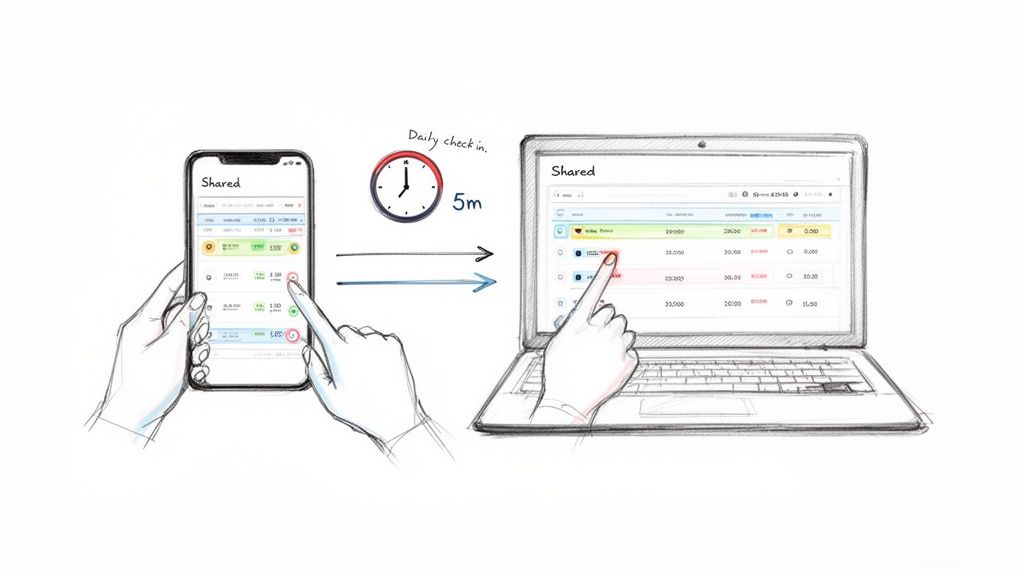
You’ve set your goals and picked a budgeting method. Awesome. But a budget is just a pretty spreadsheet until you start plugging in real numbers. This is where the magic happens—when you consistently track your spending, your financial picture snaps from a blurry guess into crystal-clear focus.
While many apps auto-sync with your bank, there’s a surprising power in manual transaction entry. The simple act of pulling out your phone and logging that $5 coffee forces a moment of mindfulness. It makes you acknowledge where your money is going.
This isn’t about shaming yourself. It’s about turning unconscious card swipes into conscious choices, which is the first real step toward changing your habits.
Make Tracking a Team Sport, Not a Solo Chore #
If you’re budgeting with a partner or family, this is where things can fall apart. When only one person is logging expenses, the budget is doomed. It quickly becomes inaccurate, and frustration starts to build.
The secret is to make tracking a shared, synchronized effort. This doesn’t mean you need to schedule another boring meeting. It’s all about creating tiny, consistent habits that keep you both in the loop.
- Try a 5-Minute Daily Sync: Find just five minutes every evening to log the day’s spending. Do it while dinner is cooking or right before you zone out with Netflix. This small habit prevents transactions from getting lost in the shuffle.
- Use a Genuinely Shared Tool: A spreadsheet saved on one person’s laptop just won’t work. A shared platform like Econumo is built for this, giving both of you a single dashboard with real-time updates. When your partner logs the grocery run, you see the “Food” category balance drop instantly.
This kind of transparency is a game-changer. It gets rid of the guesswork and the “oops, I didn’t know you already spent that” moments. It builds a sense of shared ownership, which is crucial for anyone trying to budget as a couple.
Visibility Is Your Secret Weapon #
Want to know the biggest predictor of budgeting success? It’s simply how often you look at your numbers. Research has shown that people who track expenses at least once a week are about twice as likely to stay on track as those who only check in once a month. Out of sight really is out of mind.
Consistently seeing how today’s choices affect your long-term goals is what makes the whole thing click. Tracking isn’t a punishment; it’s the real-time feedback that proves you’re making progress.
When you’re engaged, budgeting stops feeling like a chore and starts becoming a rewarding habit. You’ll begin to spot your spending triggers, celebrate hitting small milestones, and feel a real sense of control as you guide your money exactly where you want it to go.
Reviewing Your Progress and Handling Setbacks #
Let’s be real: no budget is perfect because life isn’t perfect. A tire blows out, the dishwasher finally gives up, or a surprise medical bill lands in your mailbox. It’s easy to feel like your whole financial plan just went up in smoke.
But a setback isn’t a dead end. Think of it as a stress test for your system. The real goal of budgeting isn’t flawless execution—it’s building financial resilience. It’s about learning to bend without breaking when life gets messy.
The trick is to catch problems early and make small adjustments, rather than giving up entirely. This is where a simple, consistent review process becomes your secret weapon.
Creating a Simple Review Habit #
You don’t need to spend hours buried in spreadsheets. A good budget review should be quick and to the point. Just set aside 15-20 minutes every week or two to sit down and look at the numbers. If you share finances with a partner, make sure you do this together.
This regular check-in is your early warning system. Did the grocery bill creep up again? Did you spend way more on takeout than you realized?
Catching this early means you can make a small course correction now—like moving some money from your “entertainment” category—instead of dealing with a huge deficit at the end of the month.
A budget isn’t a pass/fail test. It’s a living document designed to adapt. Viewing setbacks as learning opportunities is the single most important mindset shift for long-term success.
When Life Throws a Curveball #
Even with regular reviews, big, unexpected expenses are going to happen. This is exactly what your emergency fund is for. It’s the buffer between a surprise bill and your long-term financial goals.
When you have to dip into it, the process is straightforward: cover the expense, then tweak your budget to start refilling the fund as soon as you can.
Communication is absolutely critical during these moments, especially for couples. Using a shared budget platform like Econumo keeps these conversations grounded in data, not emotion. When both partners can see the exact same numbers, it’s much easier to agree on a plan.
Collaborative tools really do make a difference. In fact, studies on household finances show that couples who plan their money together are 10–15 percentage points more likely to have positive cash flow and enough emergency savings than those who manage their money separately. If you’re curious about the data behind this, you can learn more about the impact of joint financial planning.
Ultimately, learning how to stick to a budget is really about mastering the art of the comeback. Every setback you successfully navigate makes your financial plan stronger and your habits that much more resilient.
Common Budgeting Questions Answered #
Even the best-laid plans hit a snag now and then. Sticking to a budget is a skill you build over time, and hitting a few bumps along the road is completely normal. It’s all part of the process.
Here are some of the most common questions I hear from people trying to turn their budget from a spreadsheet into a real-life habit.
How Long Does It Take to Get Used to a Budget? #
Honestly, give yourself about 90 days. Think of it as a three-month learning curve.
Your first month is pure discovery. You’re just getting a clear, honest picture of where your money is actually going, which is often a surprise. The second month is for fine-tuning—you’ll take what you learned and set category limits that feel realistic, not punishing. By the third month, checking in and tracking your spending starts to feel less like a chore and more like a routine.
The goal isn’t to be perfect on day one. Be patient with yourself. Every week is a chance to learn something new about your habits and make your budget work better for you.
What if My Partner and I Disagree on Spending? #
Money disagreements are one of the most common hurdles for couples, especially when you’re just starting to budget together. The secret is to shift the conversation from blame to collaboration. Open communication is everything.
Try scheduling regular, low-stress “money dates.” Grab a coffee, sit down, and look at your progress together. This gives you a dedicated space to talk about finances without letting it spill into everyday arguments. Instead of pointing fingers about who spent what, use the data to see how you’re both tracking toward the goals you agreed on.
A couple of things that really help:
- Use a Shared Tool: When you’re both looking at the same numbers in real-time, the conversation becomes about the data, not about assumptions or memory.
- Create “Fun Money” Allowances: Set aside a small amount each month for both you and your partner to spend however you want, no questions asked. This little bit of financial freedom can work wonders for reducing friction over small, personal purchases.
My Income Is Irregular How Can I Budget? #
Budgeting on an irregular income feels intimidating, but it’s absolutely doable. The whole game is about creating a buffer to smooth out the financial ups and downs.
Start by figuring out your baseline budget. Look back at the last year and base it on your lowest-earning month. This number should cover your absolute, must-pay essentials. When you have a great month, resist the temptation to inflate your lifestyle. Instead, funnel that extra cash into building a solid emergency fund—aim for three to six months’ worth of those essential expenses.
Once that emergency fund is stocked, you can use any extra income to pay next month’s bills ahead of time or start aggressively tackling bigger goals. A zero-based budget is fantastic for this because it ensures every single dollar has a job, so that surplus cash doesn’t just vanish. For a more detailed breakdown, check out the steps in our comprehensive user guide on creating budgets.
Ready to build a budget that finally sticks? With Econumo, you can manage shared finances, track spending manually for greater awareness, and even self-host for complete privacy. Take control of your money by trying the live demo today at https://econumo.com.