Getting a handle on your household budget starts with a simple, honest chat. Before you get into the weeds of where your money should go, you and your partner need to sit down together, gather up all your income sources, and list out every single fixed expense. Think of it less as a math problem and more as the first step in teamwork. It’s all about creating a clear, shared picture of your financial starting point.
Building Your Financial Foundation as a Couple #
The best budgets don’t start with a spreadsheet; they start with a conversation. This isn’t just about crunching numbers. It’s about laying everything on the table to create a complete and truthful snapshot of your combined financial life. You’re essentially drawing the map before you start the journey, building your plan on a solid foundation of mutual understanding.
This simple act takes all the guesswork out of the equation and helps you avoid nasty surprises down the road. When you’re both working from the same set of facts, making decisions together becomes a whole lot easier.
Tallying Your Total Household Income #
First things first: you need a crystal-clear view of all the money coming in each month. And I mean all of it, not just your paychecks. Sit down together and make a list of every single source of income, no matter how small or irregular it might seem.
Be sure to include:
Primary Salaries: Your take-home pay (after taxes and any other deductions) from your main jobs.
Side Hustles: Any money you earn from freelance projects, a small business, or gig work.
Passive Income: Earnings from rental properties, investments, or royalties.
Other Sources: Things like child support, alimony, or any other regular payments you receive.
Add it all up. This final number is your total monthly household income—the absolute maximum you have to work with.
Identifying Your Fixed Expenses #
Next up are your fixed expenses. These are the predictable, non-negotiable costs that hit your account every single month. They’re the cornerstones of your financial life.
Grab your recent bank and credit card statements to track them down accurately. Your list will likely include:
Housing: Your mortgage or rent payment.
Utilities: The usual suspects like electricity, water, gas, and internet.
Insurance: Premiums for health, auto, home, or life insurance.
Loan Payments: Student loans, car payments, or any personal loans.
Subscriptions: Streaming services, gym memberships, software licenses, you name it.
This list forms the bedrock of your budget. These are the bills that get paid first, no questions asked. For many couples, just seeing these numbers laid out in one place is a real eye-opener.
Real-World Example: Sarah and Tom did this for the first time and had a few “aha!” moments. Tom had completely forgotten about a $300 annual professional membership that auto-renewed, and Sarah realized they were still paying for three streaming services they barely watched. That initial chat immediately saved them over $40 a month.
Okay, let’s put this into practice. Use this simple worksheet to get all your income and fixed costs down in one place. It’s the perfect starting point for your conversation.
Sample Income and Fixed Costs Worksheet #
| Category | Source or Item | Monthly Amount | Notes for Discussion |
|---|---|---|---|
| Income | Partner A Salary (Net) | $3,500 | Paid bi-weekly |
| Income | Partner B Salary (Net) | $3,800 | Includes small overtime bonus |
| Income | Freelance Writing | $400 | Varies month to month |
| Fixed Cost | Mortgage Payment | $1,850 | Includes property tax & insurance escrow |
| Fixed Cost | Car Payment (Toyota) | $375 | 2 years left on loan |
| Fixed Cost | Student Loan | $250 | Partner B’s loan |
| Fixed Cost | Car & Home Insurance | $180 | Can we shop around for a better rate? |
| Fixed Cost | Utilities (Electric, Water) | $220 | Higher in the summer due to A/C |
| Fixed Cost | Internet & Cable | $120 | Do we really need the premium cable package? |
| Fixed Cost | Streaming (Netflix, Spotify) | $35 | Let’s review which ones we actually use |
| Fixed Cost | Gym Membership | $60 | Partner A uses it 3x/week |
Once you’ve filled this out, you’ll have a powerful, unified view of your core finances. This is where a tool built for collaboration comes in handy. In Econumo, for instance, you can easily explore our guide on setting up shared access for you and your partner.
Understanding this core income-to-expense ratio is fundamental. In 2024, data showed the average U.S. consumer unit had a pre-tax annual income of $104,207 and spent $78,535. This gap highlights just how critical budgeting is for managing your money and improving your financial health, especially when the personal saving rate can be surprisingly low. You can dive deeper into these consumer expenditure trends to see how your own household stacks up.
Finding a Budgeting Method That Fits Your Lifestyle #
Okay, you’ve laid the groundwork and have a clear picture of your finances. Now for the fun part: picking a system to manage it all.
There’s no magic “best” way to budget. Honestly, the right approach is simply the one you and your partner will actually use. Think of these methods less as rigid rules and more as flexible starting points. You can (and should!) tweak them to fit your life, your goals, and your personalities.
Some couples just want a simple, big-picture view, while others get a thrill from tracking every last penny. The goal is to find a system that makes you feel in control, not constricted. Let’s walk through three of the most popular budgeting styles to see what feels right for you as a team.
This quick decision tree can help you visualize the process. It all starts with talking, then getting a handle on what’s coming in and what’s going out.
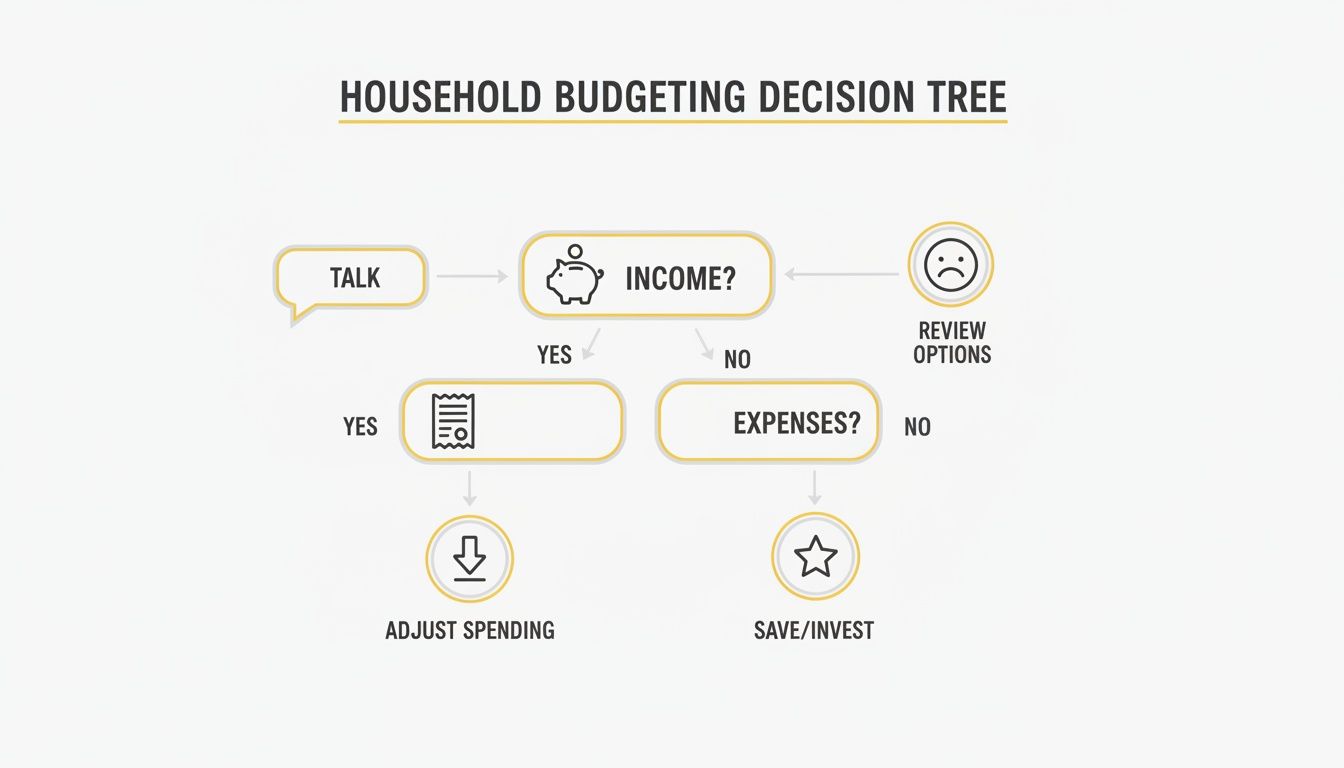
As you can see, a solid budget is built on communication first. Once you’re on the same page, you can figure out which method will work best for your income and expenses.
The 50/30/20 Rule: A Guideline for Simplicity #
If the idea of a complicated spreadsheet gives you a headache, the 50/30/20 rule is your best friend. It’s less of a strict budget and more of a simple, powerful guideline for how to divide your money. It’s all about balance.
Here’s how you split your after-tax income:
50% for Needs: This chunk covers the absolute essentials—the bills you have to pay no matter what. We’re talking mortgage or rent, utilities, insurance, car payments, groceries, and getting to work.
30% for Wants: This is the fun money! It’s for everything that makes life more enjoyable but isn’t a true necessity. Think date nights, hobbies, Netflix, vacations, and that cool gadget you’ve been eyeing.
20% for Savings & Debt: The last piece of the pie goes straight toward building your future. Use it to beef up your emergency fund, invest for retirement, save for a house, or attack high-interest debt with a vengeance.
This method is perfect for busy couples who want a high-level plan without getting lost in the weeds. It offers a ton of flexibility; as long as you stick to the percentages, you have the freedom to decide where the money goes within each bucket.
Zero-Based Budgeting: For Ultimate Control #
For couples who love details and want to know exactly where every single dollar is headed, the zero-based budget is the way to go. The core idea is simple but powerful: income - expenses = 0.
Before the month even starts, every dollar that comes in gets a job. Whether that job is paying the electric bill, going into a savings account, or being set aside for groceries, nothing is left to chance.
This approach forces you to be incredibly intentional with your money. You aren’t just tracking what you’ve spent; you’re creating a proactive plan for your entire income before you spend a dime.
It’s a straightforward process:
Start with your total monthly income (let’s say it’s $6,000).
List out every single expense you can think of—fixed costs, variable spending, debt payments, and savings goals—and assign a specific dollar amount to each.
The total of all those assigned expenses must add up to your income ($6,000), leaving you with a balance of zero.
This method is a game-changer for couples who are laser-focused on big goals, like becoming debt-free or saving up for a down payment. It pretty much eliminates mindless spending, but it definitely requires commitment and communication to track everything throughout the month.
The Envelope System: A Hands-On Approach #
The envelope system is a classic for a reason. It’s a tactile, cash-based method that makes it almost impossible to overspend. If you find yourselves swiping cards a little too freely, this can be a fantastic way to reconnect with your spending habits.
Here’s the breakdown:
At the beginning of the month, you pull out cash for your variable spending categories—things like groceries, restaurants, gas, and entertainment.
You then stuff that cash into labeled envelopes for each category, with the budgeted amount inside.
Headed to the grocery store? You can only spend what’s in the “Groceries” envelope. Once an envelope is empty, that’s it. No more spending in that category until next month.
This creates a physical hard stop that a debit card just can’t replicate. It builds incredible awareness around where your money is really going. While it’s traditionally done with physical cash, many modern budgeting apps, including Econumo, let you create digital “envelopes” to get the same level of control without having to carry cash around.
4. Map Out Your Spending Categories and Set the Limits #
Alright, you’ve got your income figured out and your non-negotiable fixed costs are on the books. Now for the fun part—giving your budget its real shape. This is where you get to decide where your money should go, based on where it has been going.
This isn’t about creating a financial straitjacket. It’s about being honest and realistic, building a plan that reflects your family’s actual life and what you both value. It’s time to dig into those variable expenses that can secretly derail a budget, like groceries, kids’ activities, and entertainment, and get them under control.
From Essentials to the Fun Stuff #
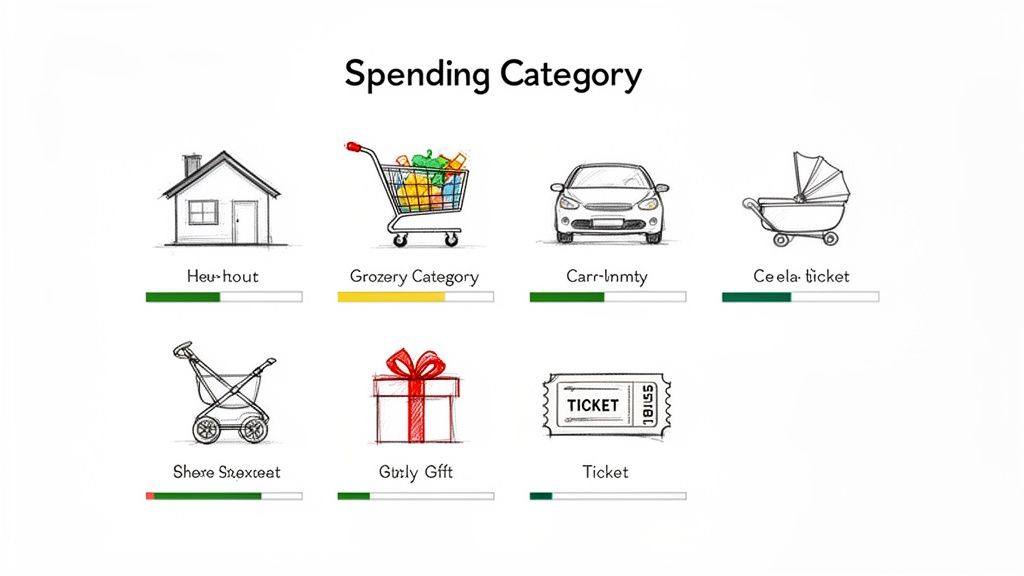
First things first, let’s group your spending into logical buckets. Some categories are obvious, but the real magic happens when you get specific. The best way to do this is to sit down together with your last two or three months of bank and credit card statements. This is your financial treasure map—it shows you exactly where the money went.
You’ll quickly see patterns emerge. Resist the urge to create a giant “Miscellaneous” category; it’s a black hole for money. The more detailed you are now, the more control you’ll have later.
Typical household budget categories look something like this:
Housing: Mortgage or rent, property taxes, HOA fees.
Utilities: Power, water, gas, internet, trash pickup.
Transportation: Car payments, gas, insurance, public transit, and repairs.
Food: I highly recommend separating Groceries and Dining Out. They serve very different needs!
Family: Childcare, school fees, sports, music lessons, pet food, and vet bills.
Personal Care: Haircuts, toiletries, gym memberships.
Entertainment: Hobbies, streaming services, date nights, tickets to a show.
Debt Repayment: Anything extra you’re paying on credit cards or student loans.
Savings & Investing: Your emergency fund, retirement accounts, and other big goals.
It goes without saying that you have to prioritize the cornerstones like shelter and utilities first. In fact, these essentials typically eat up about 18% of total U.S. household spending, a number that’s held steady for the last five years. For families, just getting these shared bills coordinated is a huge win.
Tame Irregular Costs with Sinking Funds #
One of the biggest things that can blow up a perfectly good budget isn’t the daily latte, it’s the predictable-but-infrequent expenses that ambush you. You know the ones: annual insurance bills, holiday gifts, or that car repair you know is on the horizon.
This is where a little trick called sinking funds becomes your best friend. A sinking fund is just a fancy name for a dedicated savings pot where you stash a small amount of money each month for a specific, future expense.
Here’s how it works: Let’s say your car insurance is $600 every six months. Instead of panicking to find $600 when the bill hits, you set up a sinking fund and save $100 a month. When the due date rolls around, the money is just sitting there, waiting. No stress.
This simple strategy completely smooths out your cash flow. It turns big, scary bills into small, manageable monthly line items. You can create sinking funds for pretty much anything:
Annual subscriptions (like Amazon Prime)
Holidays and birthdays
Car registration and maintenance
Family vacations
Home repairs
Agree on Realistic Spending Limits—Together #
This next step is probably the most important one: agreeing on spending limits for each category. This has to be a conversation, not a decree. The numbers you land on need to be rooted in your past spending habits and your future goals.
Pull out those bank statements again. If you see you’ve been spending an average of $800 a month on groceries, setting a new limit of $500 is a recipe for failure. Maybe you start with a more achievable goal, like $750, and see how that feels.
The conversation might sound like, “Wow, we spent $300 on eating out last month. Does that feel right to you, or should we try to trim that back to put more toward the vacation fund?”
When you make these decisions together, you both have skin in the game. It stops being about restriction and starts being about making intentional choices with your shared money.
Inside a tool like Econumo, setting these limits is a breeze. Our guide on creating and managing budgets walks you through setting up categories and limits in just a few minutes. At the end of the day, a budget you build together is a budget you’ll actually stick with.
How to Track and Adjust Your Budget Together #

A budget isn’t like a slow cooker meal; you can’t just set it and forget it. The real magic happens in the small, consistent habits you build together. Think of it as a living plan that needs regular attention to stay in sync with your life.
This is where you move from just having a budget to truly practicing financial teamwork. By creating simple routines for tracking and reviewing your progress, you stay connected to your goals and can handle financial surprises without the stress. It’s all about being flexible and talking openly, turning potential money arguments into productive conversations.
Your Weekly Spending Check-In #
Want to avoid that end-of-the-month shock when you realize you’ve overspent? A quick weekly check-in is your secret weapon. This isn’t some deep, soul-searching analysis; it’s a 15-minute sync-up to see where you both stand.
The goal is simple: log your transactions and see where the money has gone so far. This routine is surprisingly powerful because it builds mindfulness. Instead of blindly swiping a card, you both become more conscious of how each purchase fits into the bigger picture.
Here’s a simple rhythm for this weekly habit:
Gather Your Data: Both of you grab your receipts, pull up your banking apps, or check your credit card statements from the last seven days.
Log Everything: Manually enter each transaction into your budgeting tool, like Econumo. Taking the time to do this by hand really forces you to acknowledge every dollar spent.
Categorize and Confirm: Assign every purchase to its proper home. Was that Amazon order “Household Supplies” or a “Personal Fun” splurge?
This small act ensures no expense slips through the cracks. It’s also your early warning system. If a category is filling up faster than expected, you’ll have plenty of time to adjust course before the month is over.
The Monthly Budget Review Meeting #
Once a month, it’s time for your financial “state of the union.” Set aside about 30-45 minutes for a dedicated budget review. This is your dedicated time to sit down together in a calm, collaborative space to see what worked, what didn’t, and what needs to change for the month ahead.
A budget is not about perfection; it’s about progress. Your monthly meeting is where you celebrate wins, learn from mistakes, and make sure your financial plan is still serving your life, not the other way around.
This regular check-in is what makes a budget stick for the long haul. It keeps the lines of communication wide open and ensures you’re both active partners on your financial journey. Having a simple agenda keeps the conversation productive and on track.
To make these meetings run smoothly, we’ve put together a simple agenda. It ensures you cover all the important points and stay focused on making progress together.
Monthly Budget Check-In Agenda #
| Agenda Item | Discussion Points | Action Items |
|---|---|---|
| Review Last Month | Where were we over budget? Where did we come in under? Did any surprise expenses pop up? | Note any categories that consistently cause issues. |
| Celebrate Wins | What went well? Did we crush a savings goal? Did we successfully cut back in a tough category? | Acknowledge each other’s efforts and celebrate the progress. |
| Adjust for Next Month | Do we need to increase a category limit? Are there any one-off expenses coming up (e.g., a birthday, car registration)? | Reallocate funds as needed. Create new sinking funds for upcoming costs. |
| Goal Check-In | Are we still on track for our big goals (e.g., vacation fund, debt payoff)? Does our spending reflect our priorities? | Reaffirm your shared goals to stay motivated for the next month. |
Having this structure transforms a potentially tense conversation into a productive planning session.
Let’s see this in action. Imagine a couple, Alex and Jamie, are reviewing their budget. They see they only spent $150 of their $300 “Dining Out” budget. Awesome!
But they also had an unexpected $120 vet bill for their dog. They covered it with their “Miscellaneous” fund, which nearly wiped it out.
During their meeting, they decide to reallocate the $150 they saved on dining out. They move $120 back into their Miscellaneous category to replenish it and send the remaining $30 straight to their vacation savings. This simple adjustment keeps their budget whole and their goals on track, turning a potential stressor into a teamwork win. This kind of flexibility is the hallmark of a household budget that actually works.
Navigating Common Budgeting Roadblocks as a Team #
So, you’ve built your budget. But a few weeks in, things are already going off the rails. Don’t panic. This is completely normal.
Even the most carefully planned budget is going to hit a few speed bumps. The goal isn’t flawless execution from day one. It’s about building resilience as a team and figuring out how to adapt when life inevitably throws a curveball.
Think of these challenges as opportunities to get better at talking about money and fine-tuning your system. When you tackle them together, you turn a potential fight into a problem-solving session, proving you’re both on the same team.
The Overspending Dilemma #
One of the most common hurdles is blowing the budget in certain categories. Maybe groceries are costing way more than you thought, or those little online orders are adding up faster than you can track them. It’s totally normal for your first month to reveal a huge gap between your plan and reality.
Instead of getting discouraged, treat this as valuable data. If your “Dining Out” category is always in the red, that’s a clear sign your initial number was unrealistic or that old habits are just hard to break.
Here’s how to handle it:
Dig into the “why.” Is the overspending about convenience? Social plans? Or did you just genuinely underestimate how much things cost?
Try a ‘pause week.’ Halfway through the month and a category is almost empty? Challenge yourselves to a spending freeze on that specific item. Get creative and use what you already have at home.
Build in a buffer. Add a small “Miscellaneous” or “Oops Fund” to your budget. Even $50-$100 can absorb those minor overages without derailing your entire month.
Managing an Irregular Income #
If you’re a freelancer, work on commission, or run a small business, budgeting can feel like trying to hit a moving target. The secret here is to build your financial plan around your baseline, not your best month.
Start by looking at your income over the last six to twelve months to find your lowest-earning month. That number is the foundation of your household budget. All your core expenses—rent or mortgage, utilities, food, and minimum debt payments—need to be covered by this conservative figure.
Then, when you have a great month, that extra cash doesn’t just get absorbed into your daily spending. It gets a specific job based on a plan you’ve already made:
Top off your emergency fund. Get it back to a healthy level first.
Attack high-interest debt. Throw a chunk of cash at your most expensive debt.
Boost your big goals. Funnel the rest toward your major savings goals, like a down payment or that dream vacation.
This approach ensures your bills are always paid while making sure every extra dollar works as hard as possible for you.
When Financial Priorities Don’t Align #
What happens when one of you is laser-focused on paying off the mortgage, while the other is dreaming of a trip to Italy? This isn’t just common; it’s practically guaranteed. You’re two different people with your own dreams and goals.
The solution isn’t about one person “winning” the argument. It’s about finding a middle ground that respects both viewpoints and keeps you moving forward together.
Budgeting as a couple is the ultimate exercise in compromise. It forces you to define what you truly value together and then align your money with those values.
A great way to manage this is the “yours, mine, and ours” account system. You both contribute an agreed-upon amount to a joint account for all the shared bills and goals. Whatever is left over goes into your separate personal accounts. This gives each of you the freedom to spend or save on your own priorities, no questions asked. It’s the perfect blend of teamwork and independence.
No matter what, prioritizing savings in your shared budget is key to building a strong financial future. With the U.S. personal saving rate hovering at a lean 4.6% of disposable income in early 2025, a proactive budget is your best defense. You can learn more about recent personal income and spending trends to get a sense of the broader economic picture.
Have Questions About Budgeting as a Couple? You’re Not Alone. #
Jumping into shared finances for the first time? It’s completely normal to have a ton of questions. In fact, knowing what the common sticking points are—and how to handle them—can make the whole process of building a household budget feel way less intimidating.
Let’s walk through some of the most common questions I hear from couples. Think of these less as problems and more as scenarios that nearly every couple runs into at some point. Having a game plan ready will keep you focused on what really matters: your goals.
How Long Does This Actually Take? #
Getting your first budget draft sorted out will probably take a couple of hours. This is the big setup session: gathering all your financial docs, listing out every income source and expense you can think of, and having that all-important talk about your goals. Just remember, don’t chase perfection right out of the gate.
Your first month is basically a trial run. You’re just collecting data to see how your real-life spending stacks up against the plan. After that initial heavy lift, keeping it up is much, much faster.
Weekly Check-in: This is a quick 15-20 minute sync. You’re just logging recent transactions and seeing how your categories are looking. Easy.
Monthly Review: Set aside about 30-60 minutes at the end of the month. This is your meeting to see how you did, make any necessary tweaks, and plan for the month ahead.
What’s the Best Way to Handle Our Personal Spending Money? #
This is a big one. Getting this right is a total game-changer for keeping the peace.
One of the best things you can do is build separate “personal allowance” or “guilt-free spending” categories directly into your budget. This isn’t about hiding money from each other; it’s about building financial independence within your partnership.
You both just agree on a set amount each month that you can spend however you like, no questions asked. This one simple move gives you both a sense of freedom and cuts way down on disagreements over those small, random purchases. Whether it’s for a hobby, grabbing lunch with friends, or a new gadget, you both get your own money to manage within the larger plan.
This approach is so powerful because it lets you work as a team on the big goals while still respecting each other as individuals. It’s the perfect blend of teamwork and personal freedom.
How Do We Budget with an Irregular or Freelance Income? #
Budgeting with an income that goes up and down can feel like you’re building on shaky ground, but there’s a solid strategy for it. The trick is to anchor your budget to your lowest reliable monthly income, not your average or best month. Use that baseline number to cover all the absolute must-haves: housing, utilities, groceries, and minimum debt payments.
Then, when you have a good month and bring in extra cash, that money doesn’t just get absorbed into your daily spending. It gets a specific job based on a priority list you’ve already agreed on.
For example, your plan might look like this:
Top off the emergency fund until it’s fully funded.
Throw an extra payment at the highest-interest debt.
Put whatever’s left toward a big savings goal, like that vacation or a down payment.
This system stops “lifestyle creep” in its tracks—where your spending magically rises to meet your highest income—and makes sure every extra dollar is actively building a more secure future for you.
What if My Partner and I Have Totally Different Spending Habits? #
Honestly, it would be weird if you didn’t! This is probably the most common challenge couples run into. Maybe one of you is a natural saver, and the other loves to spend. The secret isn’t to try and change each other, but to shift the conversation from conflicting habits to shared goals.
Stop arguing about a $5 coffee and start talking about the future you want to build together. Do you dream of traveling the world? Buying a house? Retiring without a worry? Once you’re both excited about the same big-picture vision, finding a middle ground on the day-to-day stuff gets so much easier.
Frame your budget as the tool that will get you to those shared dreams, not as a list of rules designed to restrict you. When you both can see how cutting back a little here directly fuels a goal you’re both passionate about, the whole dynamic changes from one of sacrifice to one of empowerment.
Ready to stop guessing and start building a budget that actually works for you and your partner? Econumo provides the collaborative tools you need to manage shared bills, track spending together, and achieve your financial goals as a team. Explore the live demo or get started for free today.