If you want to get a handle on impulse spending, it all boils down to one simple thing: creating a pause. You have to build a little space between the urge to buy and the moment you actually click “purchase.” That moment of hesitation is your secret weapon against emotional spending and slick marketing. It’s what lets you sync your spending with your real financial goals, not just your in-the-moment wants.
Why You Can’t Stop Impulse Spending #

Let’s be real for a second. That little thrill you get from a spontaneous purchase feels great. It’s a quick dopamine hit, a tiny bit of control when everything else feels chaotic. The problem is, that fleeting good feeling often leaves you with a hangover of regret—and a lighter wallet.
To really get a grip on this, you have to understand what’s happening beneath the surface.
The Power of Emotional Triggers #
Most impulse buys have nothing to do with logic and everything to do with feelings. A stressful day at work, a boring Tuesday night, or even the high of celebrating a small win can send you straight to your favorite online store. We’re essentially shopping to soothe ourselves, reward ourselves, or just feel something new.
Think about it:
- Stress: After a terrible meeting, hitting “add to cart” can feel like a pressure release valve.
- Boredom: How often does mindless scrolling on your phone suddenly turn into mindless shopping?
- FOMO (Fear of Missing Out): You see your friends and favorite influencers with the newest gadget or outfit, and that powerful urge to not be left behind kicks in.
Getting a handle on your money means understanding the psychology of spending and how to control it. Once you see the patterns, you can start to break them.
External Pressures and Marketing Tactics #
It’s not just you; you’re actively being pushed to spend. Retailers are masters at designing environments that trigger snap decisions. Those limited-time offers, flashing countdown timers, and “only 2 left in stock!” alerts? They’re all designed to create a sense of urgency and bypass the rational, thinking part of your brain.
The average consumer spends a shocking $282 per month on impulse buys, totaling over $3,381 annually—enough for a family vacation you didn’t even plan.
This constant bombardment makes it incredibly easy to fall into a reactive spending trap. But there’s a simple trick that can slash this number by up to 40%: just wait 48 hours before buying anything non-essential. This “cooling-off” period gives that initial emotional high a chance to wear off, letting your logical side step back in and ask, “Do I really need this?”
Simple Tricks to Stop an Impulse Buy Now #
When the urge to spend hits, willpower alone is a losing battle. Let’s be honest, modern marketing is designed to break it. What you need are a few go-to strategies that you can pull out in the heat of the moment to stop a purchase in its tracks.
The goal here isn’t to deprive yourself; it’s to create a small but crucial pause. This pause is your secret weapon. It gives the emotional rush a chance to subside so the logical part of your brain can take over and ask the important questions.
Implement a Mandatory Waiting Period #
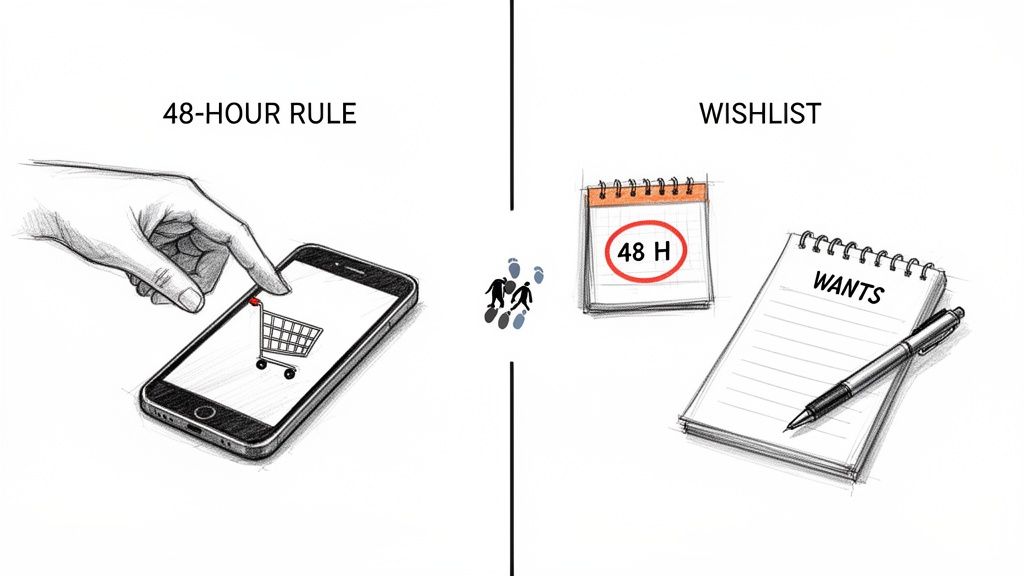
This is easily the most powerful trick in the book. The next time you see something online you feel you absolutely must have, resist the urge to click “Buy Now.” Instead, add it to your cart and just walk away. Commit to waiting at least 48 hours.
Most of the time, the initial excitement completely fades after a day or two. When you come back to that full shopping cart, you can ask, “Do I still really want this, or was I just caught up in the moment?” This simple delay weeds out a surprising number of purchases you would have regretted.
This works for brick-and-mortar stores, too. If you’re tempted by something on a shelf, physically leave the store. Go for a walk or grab a coffee. Give yourself an hour away from that carefully crafted sales environment. More often than not, the urge will vanish once you’re gone.
Add Intentional Friction to the Process #
Shopping today is dangerously easy. One-click checkouts and saved payment info make spending money a thoughtless, reflexive action. The key is to deliberately make it a little bit harder for yourself.
Here are a few practical ways to slow yourself down:
- Delete Saved Cards: Go into your browser and phone settings and remove all your saved credit card information. The simple act of having to get up and find your wallet to type in the 16-digit number gives you precious seconds to reconsider.
- Use a Wishlist: Don’t add items to your shopping cart. Put them on a dedicated wishlist instead. This shifts the action from “I’m buying this” to “I’m thinking about this,” which is a huge mental difference.
- Calculate the “Work Cost”: Before you buy, do a quick calculation: how many hours of your life do you have to trade to pay for this? A $150 pair of shoes might not sound too bad, but if you earn $25 an hour, that’s six full hours of work. Is it still worth it?
These small hurdles break the mindless scroll-and-buy cycle. They turn an unconscious habit into a conscious choice, which is the foundation for getting your spending under control for good.
For a quick-reference guide, here are some of the most effective tactics you can use the second you feel the urge to buy.
Quick Interventions to Curb Impulse Buys #
This table outlines simple, in-the-moment actions you can take to create a crucial pause before clicking “confirm purchase.”
| Tactic | How It Works | Best For |
|---|---|---|
| The 48-Hour Rule | Add the item to your cart but don’t check out. Wait two full days before revisiting the purchase. | Online shopping, especially for higher-priced “wants.” |
| Calculate Work Cost | Divide the item’s price by your hourly wage to see how many hours of your life it will cost. | Any purchase where the price feels abstract or disconnected from reality. |
| Delete Saved Payments | Remove stored credit card details from browsers and apps, forcing manual entry for every purchase. | Frequent, low-cost online purchases from sites like Amazon or food delivery apps. |
| Use a “Wants” List | Instead of adding to a cart, place desired items on a dedicated wishlist for later review. | Identifying spending patterns and delaying gratification without forgetting the item. |
Think of these as your first line of defense. They aren’t about saying “no” forever, but about giving yourself the space to say “not right now” and make a better decision later.
Building a Budget That Actually Works #
Think of a budget less as a restrictive diet and more as a permission slip to spend on what you actually care about. When you have a solid plan, you’re no longer just reacting to every sale or fleeting desire. Instead, you’re proactively telling your money where to go, turning spending from a source of guilt into a series of intentional choices.
This shift from reactive to proactive is your best defense against impulse spending. It’s a real problem, too—a startling 54% of shoppers admit to spending over $100 on a single impulse buy, and 20% have even blown past the $1,000 mark. Those momentary thrills often lead to long-term regret.
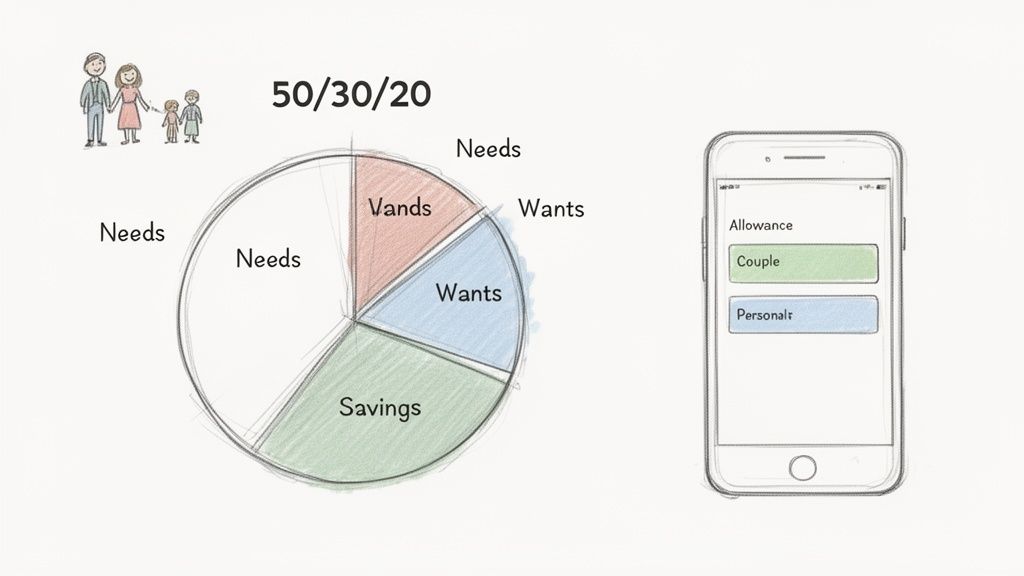
A proven way to fight back is the 50/30/20 budgeting rule. By creating clear boundaries for your money, it has been shown to slash impulse spending by as much as 35%.
The 50/30/20 Rule Explained #
This framework is popular for a reason: it’s incredibly simple and effective. You just break down your after-tax income into three buckets, which immediately shows you where those unplanned purchases are wrecking your progress.
- 50% for Needs: This is for the absolute essentials. We’re talking about your mortgage or rent, utilities, groceries, car payments, and insurance—the things you have to pay to keep the lights on.
- 30% for Wants: This is your lifestyle money. It covers dining out, hobbies, streaming subscriptions, and that new gadget you’ve been eyeing. This category gives you room to enjoy life, but it’s also where discipline is key.
- 20% for Savings and Debt: This chunk is all about your future. Use it to build an emergency fund, invest for retirement, and aggressively pay down high-interest debt like credit cards.
When you lay it all out like this, you can instantly see that a $150 impulse splurge isn’t just a $150 purchase. It’s $150 that’s no longer going toward your vacation fund or helping you get out of debt faster.
Budgeting as a Team Sport #
If you’re in a relationship or have a family, getting on the same financial page is non-negotiable. When spending habits don’t align, it creates friction and can seriously derail your shared goals. That’s why it’s so important to treat budgeting as a team effort.
A shared budget isn’t about controlling your partner’s every purchase. It’s about being transparent, staying accountable, and agreeing on a shared vision for your future—then working together to make it a reality.
A collaborative tool helps you set up joint budgets for shared costs like groceries and bills while also allowing for separate personal allowances. This way, both partners get a sense of financial freedom and autonomy within a structure you both agreed on. It’s a great way to sidestep money arguments before they even begin.
To help solidify your plan, a physical tool like a downloadable free budget tracker printable can be a fantastic way to reinforce your commitment. And if you’re someone who prefers a more hands-on approach, you might find our guide on the cash envelope system really helpful. You can learn more here: https://econumo.com/posts/cash-envelope-budgeting-system/
Using Technology to Build Better Habits #
In the fight against impulse spending, your phone can feel like the enemy. It’s a constant stream of tempting ads and one-click-buy buttons. But if you’re smart about it, that same device can become your most powerful ally. It’s not about finding some magic app that fixes everything; it’s about picking tools that force you to be more aware and build real discipline.
The key is to be intentional with your tech. Instead of using apps that hide your spending in the background with automation, you need tools that put every dollar front and center.
Make Every Purchase a Conscious Choice #
Most budgeting apps today brag about their automatic syncing. Sure, it’s convenient. But that convenience has a downside: it makes spending a passive, almost invisible act. The money just vanishes from your account, and you never have to consciously acknowledge the decision.
Here’s a different way to think about it: manual transaction entry. I know, it sounds like a total chore at first. But trust me, it’s one of the most powerful mindfulness exercises you can do for your finances. The simple act of opening an app and typing in what you just spent—whether it’s $5 for a coffee or $50 on lunch—forces you to pause and reflect.
That brief pause creates a powerful feedback loop. You’re not just spending money; you’re recording a decision. Over time, this tiny action makes you so much more aware of where your money is actually going. It strengthens your ability to stop and ask, “Do I really need this?”
Manually entering your purchases interrupts that mindless tap-and-go habit. It transforms spending from a knee-jerk reaction into a deliberate choice, which is exactly what you need to get impulse buys under control.
Get on the Same Page with Your Partner #
For couples and families, the right tech can be the neutral territory where you finally have productive conversations about money. When everyone is looking at the same numbers on a shared platform, budgeting becomes a team sport instead of a source of conflict. Setting up joint budgets in an app gives you a built-in system for mutual support.
This kind of setup lets you:
- Track shared expenses like groceries, utilities, and rent in one place where nothing is hidden.
- Set and work toward shared goals, like saving for a vacation or a down payment on a house.
- Keep your independence with separate allowances for personal spending.
When both you and your partner can see how your individual spending affects your shared goals in real-time, it creates natural accountability. It just keeps you both pulling in the same direction. For some great options, check out our guide on the best free budgeting software you can get today.
Take Back Control with Privacy and Flexibility #
Don’t just look at the features; look at the technology behind the tool. A lot of free platforms are free because they’re mining your financial data to sell you more stuff. They’re literally fueling the very consumerism you’re trying to escape.
Choosing a self-hosted budgeting solution means you own your data, period. That privacy is a powerful shield against the hyper-targeted ads designed to trigger your specific spending weaknesses.
And if you’re an expat, a digital nomad, or just someone who deals with money in different countries, multi-currency support is a non-negotiable. Being able to track your spending and budgets in their native currencies gives you a clear, honest picture of your finances. It stops you from doing fuzzy mental math that can hide the true cost of a purchase, helping you stay in control no matter where you are.
Making Mindful Spending a Lifelong Habit #
Let’s be honest: real, lasting change isn’t about white-knuckling your way through every temptation. Willpower runs out. The real secret is building new routines until mindful spending becomes your new normal, something that runs on autopilot.
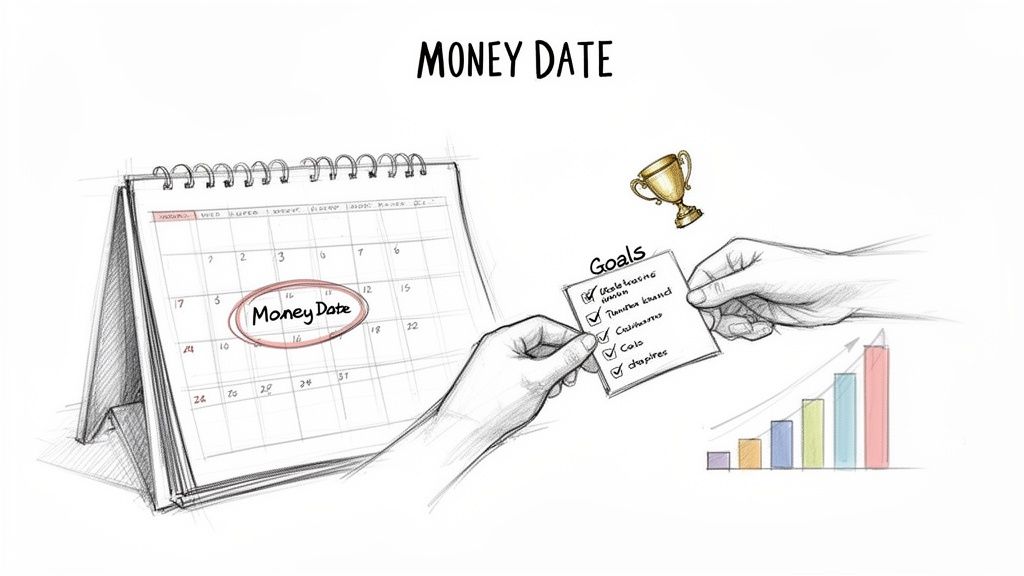
For couples and families, this has to be a team sport. One of the best ways I’ve seen this work is by scheduling regular ‘money dates’. This isn’t a time to point fingers about who spent what. It’s a dedicated, judgment-free window to get on the same page.
Set aside time each week or month to look at your budget together, chat about upcoming bills, and, most importantly, talk about your shared dreams. This simple act turns budgeting from a chore you both dread into a way to actively build the life you want together.
Setting Goals That Actually Motivate You #
It’s a lot easier to say “no” to a quick impulse buy when you have a powerful “yes” you’re working toward. Vague goals like “save more money” just don’t have the emotional kick needed to change your behavior on a rainy Tuesday. You need a vision that gets you genuinely excited.
Think about what you’re really saving for. Get specific.
- A tangible target: “We want to save $10,000 for a down payment on a house in that neighborhood with the big trees.”
- A clear finish line: “My goal is to be completely credit card debt-free in 18 months.”
- An amazing experience: “Let’s put away $4,000 so we can take that two-week trip to Italy for our anniversary.”
When your goal is crystal clear and exciting, every dollar you don’t spend on a whim feels like a direct investment in a future you actually want. Suddenly, saving isn’t about deprivation—it’s about empowerment.
Write your goals down. Put them on the fridge, a sticky note on your monitor, or make it your phone’s lock screen. Seeing that reminder every single day keeps your long-term vision front and center when a short-term temptation tries to grab your attention.
The Power of Shared Accountability #
Trying to break old habits all by yourself is tough. It can feel pretty isolating. Bringing someone else into the loop adds a layer of support and encouragement that can make all the difference. For individuals, this often looks like finding an ‘accountability buddy’.
This could be a good friend or a family member you trust. Just knowing you have a regular check-in where you’ll share your progress—the wins and the slip-ups—can be a powerful nudge to stay on course.
You can also find great support in online financial wellness communities. They’re a fantastic place to celebrate wins, get advice when you’re stuck, and see that you’re not the only one on this journey.
Remember, getting a handle on your spending is a practice, not a one-time fix. Celebrate the small victories, like sticking to your grocery budget or walking away from an online sale. Those little wins build the momentum you need for the long haul. And if you’re looking for fun ways to kickstart your savings, you could try something like the 100 envelope challenge.
Frequently Asked Questions #
You’ve got the basics down, but let’s be real—life gets complicated. When you’re in the thick of it, trying to change your spending habits, specific questions always pop up. Here are some of the most common ones I hear, along with some straight-up advice.
How Long Does It Actually Take to Stop Impulse Spending? #
I wish I could give you a clean 30-day timeline, but it just doesn’t work that way. Think weeks, sometimes months, to really lock in a new habit. The most important thing to remember is that consistency beats perfection every single time. Seriously. Don’t try to overhaul your entire financial life overnight.
Pick one or two small things to start with. A great one is the 48-hour rule for any online purchase over $50. Just try that. Every time you successfully walk away from an impulse buy, you’re doing a rep for your financial self-discipline muscle.
Don’t beat yourself up when you slip. It’s going to happen. This is all about making steady progress, not keeping a perfect score. Seeing your spending tracked in an app can be a huge motivator—it shows you how all those small, consistent wins add up to big savings.
It’s less like flipping a switch and more like training for a marathon. Each small victory makes you stronger for the next mile.
What if My Partner Is the One with the Spending Problem? #
This is a tough one, and it’s incredibly common. The only way through it is by tackling it as a team, not as a battle. Pointing fingers just makes people defensive. The key is to pick a calm, neutral time to talk—definitely not right after a big, unplanned Amazon delivery shows up.
Frame the conversation around your shared goals. Don’t make it about the spending itself, but about what the spending is preventing. Talk about that vacation you both keep dreaming of, or the relief you’d feel paying off a credit card. A budget isn’t a straitjacket; it’s the road map to get you to those goals together.
A few things that really work:
- Get on the same page with a shared app. When you both see the same numbers in a joint budget, it creates transparency and takes the emotion out of it.
- Give each other a personal spending allowance. This is non-negotiable. It gives both of you the freedom to buy stuff you want, no questions asked, as long as it’s within that set amount.
- Schedule quick, casual “money dates.” Once a week or every two weeks, just check in on your progress and make a simple plan for the weeks ahead. Keep it light.
This shifts the dynamic from one person being the “bad guy” to both of you working toward the same finish line.
Is an Occasional Impulse Buy Really That Bad? #
Not at all! The goal isn’t to suck all the joy out of life or make you feel guilty for buying a coffee. A healthy financial plan has room for fun. The whole point is to make sure your spending aligns with what you truly value.
The problem isn’t the one-off treat; it’s when those impulse buys become a constant habit that causes stress, debt, or regret. When you build a budget using a simple framework like the 50/30/20 rule, you’re literally setting money aside for your “wants.”
That means you can go ahead and buy the concert tickets or that new gadget completely guilt-free. You can enjoy it because you know your bills are covered and your savings are on track. It’s all about spending with intention, not deprivation.
Ready to stop reacting and start planning? You can build a budget that actually works for you and your family. Get started with Econumo and see how our collaborative, privacy-focused tools can help. Check out the live demo to see how simple it is to manage your money with intention.