When your income swings up and down each month, standard budgeting advice can feel like it was written for a different planet. The key to getting a handle on things isn’t about guessing what you’ll earn next month. Instead, it’s about creating a rock-solid plan based on your absolute essentials.
This means building what I call a ‘bare-bones’ budget. You figure out the bare minimum you need to get by and base your entire financial plan on that number. It’s a simple shift, but it’s what gives you stability when your paycheck feels anything but stable.
The Reality of Budgeting with a Fluctuating Paycheck #

If you’re a freelancer, a small business owner, or work on commission, you know the feeling. The thrill of a great month is often followed by the anxiety of a slow one. Traditional budgeting tells you to plan around a consistent salary, which is frustratingly useless when your income is a moving target.
It’s one thing to hear this, but another to live it. How do you plan for groceries when your income could be $2,500 one month and just $1,200 the next? This isn’t a niche problem; it’s the daily reality for roughly 36% of the U.S. workforce—that’s about 59 million people navigating the gig economy. You can dive deeper into these budgeting insights on Nasdaq.
Prioritizing Your Financial Foundation #
To get control, you have to flip your perspective. Stop budgeting based on what you hope to make. Start budgeting based on what you absolutely need to survive. This means identifying and protecting your “four walls” before a single dollar goes anywhere else.
These are your non-negotiable, core priorities:
- Food: What you need for groceries and basic household supplies.
- Utilities: Keeping the lights on, the water running, and the internet connected.
- Shelter: Your rent or mortgage payment.
- Transportation: The money required to get to work and handle essential errands.
By building your budget around just these four pillars, and using your worst month’s income as the foundation, you create a financial safety net. Every dollar you earn above that baseline can then be put to work intentionally.
This isn’t about feeling restricted; it’s about creating order out of chaos. Once your essentials are covered, you regain control. That surplus can now go toward savings, paying down debt, or getting ready for the next slow month.
Embracing the Baseline Budget Method #
I call this the baseline budgeting method, and it’s the cornerstone of making this work. It forces you to build from a place of security, ensuring your most critical bills are always paid, no matter how the month turns out. Anything extra becomes a tool for building wealth, not just for survival.
Here’s a quick look at how this simple but powerful method breaks down.
The Baseline Budgeting Method at a Glance #
| Principle | Actionable Step | Why It Works |
|---|---|---|
| Budget from the Bottom-Up | Find your lowest income from the past 6-12 months. Use this figure as your baseline monthly income for budgeting. | It creates a worst-case-scenario plan, so you’re never caught off guard. |
| “Four Walls” First | List the costs for your four essentials: Food, Utilities, Shelter, and Transportation. This is your core budget. | It guarantees your fundamental needs are met before any other spending, preventing crisis. |
| Treat Surplus as a Bonus | Any income earned above your baseline is allocated after your core needs are funded. | This prevents lifestyle inflation and turns extra income into a tool for progress (savings, debt, etc.). |
Adopting this mindset shifts you from being reactive and stressed to proactive and in control. You’re no longer scrambling when a client pays late. Instead, you have a clear, repeatable plan that buys you peace of mind and lays the groundwork for real financial stability. It’s the essential first step to mastering your money when your income is unpredictable.
Calculating Your Financial Baseline #
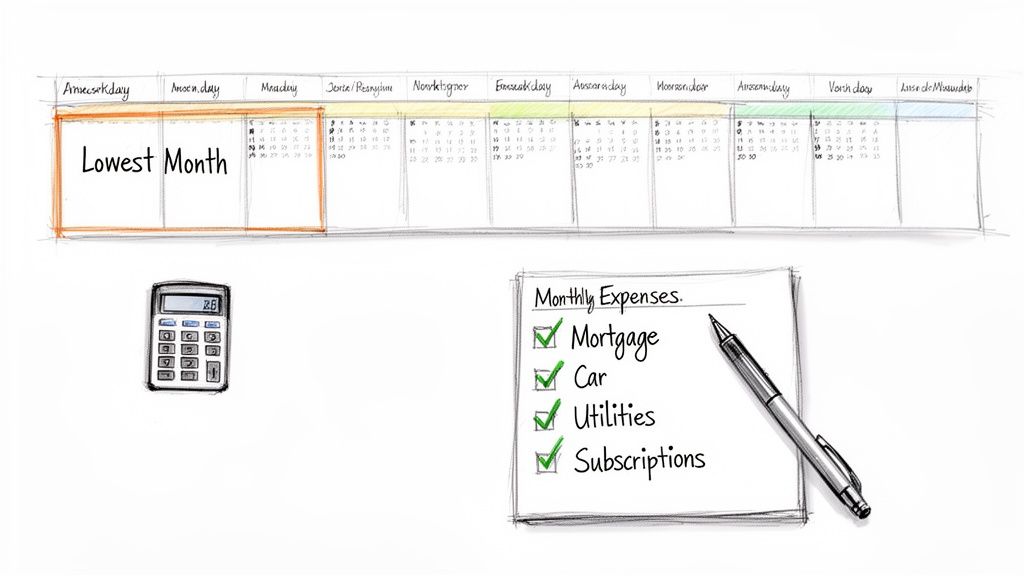
Before you can build a budget that actually works, you need to get crystal clear on two things: your baseline income and your total monthly expenses. This isn’t about judging past spending habits. It’s about gaining the clarity you need to build a financial future free from stress.
This process means digging into your financial history to figure out what a “normal” month looks like, even when every month is different. This baseline becomes your anchor, the number you can trust to keep everything running, no matter how much your income swings.
Find Your Baseline Income Figure #
First things first, you need a reliable income figure to build your budget around. Trying to guess what you’ll make next month is just a recipe for anxiety. A much better approach is to look at what you’ve actually earned in the past. When you’re budgeting for irregular income, there are two straightforward ways to do this.
The Lowest Month Method is the most conservative and, frankly, the safest route.
- Pull up your income statements from the last 6 to 12 months.
- Find the single month where you earned the least amount.
- Use that number as your official monthly income for your budget.
This approach forces you to build a plan that can withstand a worst-case scenario. If you know you can cover all your essentials with your lowest-ever income, you’ll feel secure no matter what the next month brings.
Another option is the Averaging Method, which gives you a slightly more optimistic, yet still realistic, number to work with.
- Add up your total income from the last 6 to 12 months.
- Divide that total by the number of months you used (6 or 12).
- The result is your average monthly income.
This works well if your income fluctuates but doesn’t have wild peaks and valleys. Be careful, though: if you budget based on an average, you absolutely must have a buffer fund to see you through the months when you inevitably earn less than that average.
No matter which method you pick, the goal is the same: replace guesswork with a concrete number. This figure isn’t just a suggestion—it’s the cornerstone of your entire financial plan.
Catalog Every Single Expense #
Once you’ve got your baseline income, it’s time to get a precise total of what it costs to run your life each month. This means doing a full audit of your spending. You need to account for everything, from the big bills you can’t miss to the small, recurring charges that are easy to forget.
Start by listing out your fixed expenses. These are the bills that are generally the same amount every month and are totally non-negotiable.
- Housing: Rent or mortgage payment.
- Transportation: Car payments or public transit passes.
- Insurance: Health, auto, home, or renters insurance premiums.
- Debt Payments: Minimum payments on student loans, credit cards, or personal loans.
Next, it’s time to tackle your variable expenses. These costs change month to month, but they’re still essential. The best way to get a handle on them is to look at your last three months of bank and credit card statements to find a realistic average for each category.
- Groceries: This includes all food and household supplies.
- Utilities: Electricity, water, gas, and internet.
- Fuel: Gasoline for your car.
Finally, don’t let the periodic or non-monthly expenses sneak up and wreck your budget. These are the surprise costs that can throw everything off track if you’re not prepared.
- Annual subscriptions (like streaming services or software).
- Car registration and maintenance.
- Holiday or birthday gifts.
- Quarterly estimated tax payments.
Add these up, divide by 12 to get a monthly cost, and then add that amount to your expense total.
This is where a tool that allows for manual entry, like Econumo, can really shine. Physically typing in each expense forces you to acknowledge every dollar you spend, which creates a powerful sense of awareness and control. You can learn more about how to set this up by reading our guide on creating and managing budgets. This detailed tracking gives you your true “survival number”—the absolute minimum you need to keep the lights on each month.
Prioritizing Spending with The Four Walls System #
When your income swings up and down, knowing exactly where your first dollar must go is a superpower. Without a plan, you’re just guessing, and that guesswork breeds anxiety and missed bills, especially when a lean month hits. This is where a simple, priority-based system becomes your most powerful tool for budgeting for irregular income.
The Four Walls system gives you that much-needed clarity. It’s a straightforward framework that forces you to cover your family’s most critical needs first—no exceptions. Think of it as building your financial house on a rock-solid foundation, protecting it from the storms of income volatility.
What Are The Four Walls? #
The Four Walls represent your absolute survival needs. Before a single dollar goes to a credit card bill or a vacation fund, you make sure these four categories are completely taken care of.
- Shelter: This is your rent or mortgage payment. Keeping a roof over your head is always priority number one.
- Utilities: We’re talking about electricity, water, natural gas, and any internet service you need for work or school. You’ve got to keep the lights on and the water running.
- Food: This is your grocery budget—the money you need to feed your family, not for dining out.
- Transportation: This covers the bare-minimum cost to get to your job or handle essential errands, like gas for the car or a public transit pass.
By defining these non-negotiables ahead of time, you strip the emotion out of your spending decisions. There’s no agonizing over what gets paid first when you have a clear, pre-defined plan.
Putting The Four Walls Into Practice #
Let’s see how this works in the real world. Imagine a family of four—a freelance graphic designer and a stay-at-home parent—with a baseline budget of $3,500 per month for their essentials.
In a lean month, their income is only $3,800. With the Four Walls system, their priority list is crystal clear.
- Fund The Four Walls First ($3,000): The $1,800 mortgage, $400 for utilities, $600 for groceries, and $200 for fuel get paid immediately. This is non-negotiable.
- Cover Other Essentials Next ($500): After the walls are secure, they pay for critical insurance premiums and make minimum debt payments. This keeps them in good standing without risking their core needs.
- Pause Everything Else: With only $300 left over, all non-essential spending stops. No savings contributions, no extra debt payments, and no discretionary spending. The goal is simply to get through the month.
Now, let’s flip the script to a good month where their income hits $5,500. The process starts the same but ends very differently.
- Fund The Four Walls First ($3,000): As always, the essentials are covered.
- Cover Other Essentials ($500): Minimums and insurance are paid.
- Allocate The Surplus ($2,000): With the extra cash, they can make real progress. They might throw an extra $1,000 at a high-interest credit card, put $750 into their income smoothing fund, and set aside $250 for a well-deserved family outing.
This structured approach transforms money management from a stressful guessing game into a repeatable process. It ensures that no matter how much you make in a given month, your core survival needs are always met first.
Why This System Is Crucial #
This disciplined approach is vital for anyone with a fluctuating income, but it’s especially critical for those who are most vulnerable. Income volatility hits low-income households the hardest, with nearly 40% reporting irregular schedules. As a result, they often have trouble paying bills 3.5 times more often than their high-income peers. The Brookings Institution’s analysis offers some sobering insights into these labor trends.
If you’re just starting to get this detailed with your finances, our guide on how to create a household budget is the perfect place to begin listing and categorizing your expenses. The Four Walls system then builds on that foundation by adding a crucial layer of prioritization—the key to navigating a variable income successfully. It creates a clear hierarchy for your money and gives you the peace of mind that your most important obligations are always handled.
Building Your Income Smoothing Fund #
The real secret weapon for anyone trying to budget for irregular income isn’t a fancy spreadsheet or a set of rigid rules—it’s a dedicated cash buffer. Now, this isn’t your emergency fund. That’s for true, unexpected crises like a blown transmission or a surprise medical bill.
This is an income smoothing fund. Its only job is to turn your chaotic cash flow into a predictable, stable monthly “salary.”
Think of it as your personal financial reservoir. During the rainy seasons (your big-income months), you fill it to the brim. When a drought hits (a slow month), you just open the tap to cover your expenses without a shred of stress. This fund is what lets you pay your bills on time, every time, even when a client pays late or work dries up for a bit. It’s how you transform financial chaos into calm.
Without this buffer, you’re stuck on the income rollercoaster. A recent Federal Reserve report found that nearly 40% of Americans would have trouble covering an unexpected $400 expense. A smoothing fund is your best defense against becoming part of that statistic. It ensures that one low-income month doesn’t instantly become a full-blown financial emergency.
Calculating Your Smoothing Fund Target #
So, how big does this fund need to be? The goal is to have enough cash on hand to bridge the gap between your lean-month income and your essential expenses for a while. A solid rule of thumb is to save one to three months’ worth of your core, non-negotiable expenses.
Here’s a simple way to figure out your target number:
- Tally Your Monthly Essentials: Grab that expense list you made earlier. Add up everything that falls under your Four Walls, plus other critical bills like insurance and minimum debt payments. Let’s say that comes out to $3,500.
- Find Your Lowest Earning Month: Look back over the past year or two and pinpoint your worst month for income. For this example, we’ll say it was $2,500.
- Calculate the Shortfall: The difference between your essential spending and your lowest income is the biggest gap you’d need to fill in a bad month. Here, that’s $3,500 - $2,500 = $1,000.
- Set Your Target: Now, multiply that shortfall by how many months of cushion you want. For a comfortable three-month buffer, your goal would be $1,000 x 3 = $3,000.
That $3,000 is your magic number. It’s the amount of money that lets you sleep at night, knowing you can weather three straight lean months without breaking a sweat.
An income smoothing fund is not a ’nice-to-have.’ It’s the core engine that makes budgeting on a variable income possible. It buys you consistency and, more importantly, peace of mind.
How to Build and Manage Your Fund #
Getting this fund started takes some discipline, especially at first. Every time you have a great month where your income blows past your baseline budget, a big chunk of that surplus needs to go directly into your smoothing fund. It should be your top priority right after your Four Walls are secure.
To make the system stick, be intentional about where you keep the money.
- Keep It Separate: Open a new high-yield savings account just for this fund. Don’t let it get mixed up with your daily checking account or your long-term emergency fund. Keeping it separate is the key to not spending it by accident.
- Give It a Name: Actually label the account “Income Smoothing Fund” or “Paycheck Buffer.” This little psychological trick constantly reminds you of its purpose and makes you think twice before raiding it for a new gadget.
This diagram shows you exactly where building this fund fits into your spending priorities—it’s what you do after the absolute essentials are covered.

The flow is simple: take care of your essentials first. Then, any surplus income goes toward building and refilling this crucial buffer.
Using the fund is just as important as building it. When a month rolls around and you only bring in $2,500 but your core bills total $3,500, you simply transfer $1,000 from your smoothing fund into your checking account. Boom—you’ve just paid yourself the difference and created a stable, predictable income out of thin air.
The next time you have a great month, your first job is to replenish what you used, always aiming to get the fund back to its target. This disciplined cycle is what will finally set you free from the financial stress of an irregular income.
Taking Control of Your Cash Flow #
Once you’ve got your baseline budget figured out and your income smoothing fund is in place, you can finally shift from defense to offense. These next strategies are all about building the consistency your income lacks, turning that unpredictability into a structured cash flow system that actually works for you.
We’re moving beyond just surviving the lean months. The goal here is to engineer stability where none naturally exists. It’s time to treat your personal finances with the same discipline as a small business—which, for many freelancers and gig workers, is exactly what you’re running.
Pay Yourself a Consistent Salary #
This is one of the most powerful changes you can make. Stop trying to live directly out of your business earnings. Instead, create a system where you pay yourself a regular, fixed salary, just like you would at a traditional job. This one move can single-handedly stop the financial rollercoaster.
Here’s how it works in practice:
- Set up a dedicated income account. Open a separate business checking account and direct all your client payments, commissions, and other earnings there. This is your income hub—you don’t use it for personal spending.
- Decide on your “paycheck.” Look at that lean-month budget you built. That’s your number. That’s the fixed amount you need to cover your expenses, and it becomes your consistent salary, whether you pay it to yourself bi-weekly or monthly.
- Automate your payday. Set up a recurring, automatic transfer from your income account to your personal checking account. Imagine that—a predictable “paycheck” arriving like clockwork on the 1st and 15th.
Any money left in the income account after you’ve paid yourself is your surplus. That’s what you use to refill your income smoothing fund, set aside for taxes, and eventually funnel toward investing or smashing debt. This system forces discipline and creates the predictability you’ve been missing.
Taming the Tax Beast #
If you’re not a W-2 employee, taxes aren’t just a once-a-year headache; they’re a constant reality. Nothing will derail your progress faster than a surprise tax bill. The trick is to start treating taxes like any other recurring business expense.
A good rule of thumb to start with is the 30% Rule. For every single dollar you earn, immediately set aside 30% of it just for taxes. You might need to adjust this up or down depending on your income, deductions, and local laws, but it’s a very safe starting point.
Just like your smoothing fund, this tax money needs its own dedicated home. Open a separate high-yield savings account, label it “Tax Fund,” and transfer that percentage in the second you get paid. Never, ever touch this money for anything else.
This simple habit takes all the stress out of quarterly estimated payments. When the deadline rolls around, the cash is just sitting there, waiting for you. No panic, no scrambling.
Strategies for Couples and Families #
Managing an irregular income gets more complex with a partner, but it’s also a huge opportunity for teamwork. If one person has a stable salary and the other has a variable income, you can build a really powerful financial foundation together.
Here’s a common and effective approach:
- The stable income covers the “Four Walls.” The partner with the consistent paycheck takes responsibility for the absolute essentials: mortgage/rent, utilities, groceries, and transportation. This guarantees the family’s core needs are always met, no matter what.
- The variable income becomes your power tool. Once that irregular income hits the bank, its first job is to top off the income smoothing fund. After that, it gets deployed to accelerate your financial goals—aggressively paying down debt, building investments, or saving for big purchases like a car or down payment.
For this to work, you need total transparency. Using a shared budgeting app is non-negotiable here. It keeps both partners on the same page and turns budgeting from a source of conflict into a shared mission. With clear and continuous expense tracking, you can both see where money is going and track your progress together.
The volatility that hits individuals also impacts households. It’s not just a challenge for freelancers; many families deal with major income swings. Recent data shows that UK households can see their income fluctuate by over £500 a month, often leading them to pay more for essential services. You can read more about these hidden costs of income volatility from Nest Insight. Putting these strategies into action is your best defense against that kind of instability.
Your Questions on Irregular Income Answered #
Once you get the hang of the basics—like setting up a baseline budget and building a buffer—the real-world questions start popping up. Standard financial advice often misses the nuances of a fluctuating paycheck, so let’s dig into some of the most common challenges people run into.
This is where the theory gets put to the test. You might be wondering how to make this work with a partner, what to do about debt, or how to manage money when you’re dealing with more than one currency. Getting these details right is what turns a good plan into a great one, giving you the confidence to build real financial stability.
How Do We Budget as a Couple with Irregular Incomes? #
When both partners have variable paychecks, getting on the same page isn’t just important—it’s everything. The first thing you need to do is track all your combined income and expenses for a couple of months. No guesswork. This gives you a clear, shared picture of where your money is actually going.
With that data in hand, you can build a unified household budget based on your combined leanest month. From there, decide how you’ll fund it. Some couples pool every last dollar into a joint account, while others find it works better to contribute a percentage of their individual earnings.
The most critical part is making decisions together.
- Cover the “Four Walls” first: Before anything else, use your combined income to lock down the absolute essentials: shelter, utilities, food, and transportation.
- Plan for the surplus as a team: When you have a great month, that extra cash is a shared win. Decide together how to best use it to hit your goals faster.
- Use a shared system: A joint budgeting tool is a game-changer. It eliminates secrets and misunderstandings, keeping everyone on the same financial page.
Approaching it this way turns a potential source of stress into a team effort, making both your finances and your relationship stronger.
What’s the Difference Between a Smoothing Fund and an Emergency Fund? #
This is a big one, and the confusion is understandable. But mixing these two up can put your entire financial safety net at risk. They look similar, but they have two completely different jobs.
An emergency fund is your break-glass-in-case-of-emergency money. It’s for the truly unexpected, big-ticket life events: a sudden job loss, a medical crisis, or your roof caving in. This is your ultimate financial lifeboat, and you should aim to have 3-6 months of essential living expenses tucked away. You don’t touch it unless it’s a real, genuine emergency.
An income smoothing fund, on the other hand, is all about cash flow. Its job is to fill the predictable gaps between your income and your expenses in a lean month. If your baseline budget is $4,000 but you only bring in $3,200, you pull $800 from the smoothing fund to cover the difference. When a high-income month rolls around, you pay it back.
Think of it this way: the smoothing fund is your monthly shock absorber, while the emergency fund is your last line of defense.
How Should I Handle Credit Cards and Debt? #
Very, very carefully. When income dips, reaching for a credit card can feel like an easy solution, but it’s a dangerous trap that can quickly spiral into high-interest debt. This is exactly the problem your income smoothing fund is built to prevent.
During those lean months, your focus has to be razor-sharp. After your Four Walls are paid for, the only other priority is making the minimum payments on all your debts. This keeps your accounts in good standing without forcing you to sacrifice your essential needs.
Then, when you have a high-income month, you can switch from defense to offense. Earmark a portion of that surplus to throw at your highest-interest debt, like credit cards or personal loans. But remember, your first priority is always to build and maintain a healthy smoothing fund. That buffer is your single best weapon against taking on new debt.
I’m an Expat with Income in Multiple Currencies. How Does That Affect My Budget? #
Living and working internationally adds another layer of unpredictability to the mix: fluctuating exchange rates. The core principles of budgeting with a variable income still apply, but you’ll need to be a bit more conservative and lean on the right tools to keep everything straight.
First, establish your baseline budget in your primary living currency—the one you use for most of your day-to-day bills. It’s also a smart move to build a slightly larger income smoothing fund, maybe aiming for 3-4 months of expenses instead of the usual 1-3. This extra cushion gives you a buffer against both a drop in income and a sudden, unfavorable swing in the exchange rate.
For expats, a tool with solid multi-currency support isn’t a luxury; it’s a necessity. Trying to manually convert every transaction is a headache and a recipe for mistakes. A system that can track your accounts in their native currencies gives you an accurate, real-time snapshot of your entire financial world. This is precisely why we built multi-currency support into Econumo—to make it the perfect fit for global citizens.
Ready to take control of your variable income with a tool built for flexibility and collaboration? Econumo provides multi-currency support, joint accounts for couples, and the mindful control of manual entry. See how it works with a live demo and join the waiting list for our cloud release at https://econumo.com.